Past issueLatest issue →

The Foundations Loosen

Lead story · Intelligence01 / 04
Intelligence — AI37.3541° N, 121.9552° WSanta ClaraIssue No. 3Status · Reported, not confirmed

Nvidia Board Meets to Weigh Removing CEO Jensen Huang

Nvidia's board is reportedly preparing to dismiss chief executive Jensen Huang over two alleged extramarital affairs, and the news is already hitting markets. Bets tracking Nvidia on the crypto exchange Hyperliquid fell as much as 10 percent as the reports spread.

01What happened

Nvidia's board was set to meet late Wednesday to decide whether to oust Jensen Huang, the longtime leader of the company whose chips power much of the current artificial intelligence boom, according to reporting from The Wall Street Journal. The Journal said the board was preparing to remove Huang following a New York Times report about a second alleged extramarital affair. That came just days after Huang admitted to a separate affair with a woman who has been alleged to be a Chinese spy. The second alleged affair, the reports say, involved an executive at the company.

The stakes extend beyond one company. Huang runs one of the world's most valuable firms, controls the in-demand technology fueling the AI race, and keeps close ties with presidents and corporate leaders, a profile that made him an obvious espionage target. The allegation of a link to a Chinese spy lands at a moment when the United States is seen as leading that race, raising questions about whether a scandal at the top could undercut that position.

02How markets reacted

−10%
NVDA perps · HyperliquidAs much as, as the reports spread

The leadership turmoil rattled traders. On Hyperliquid, a cryptocurrency exchange, so-called perpetual futures tied to Nvidia fell as much as 10 percent as word of the possible ouster spread. Perpetual futures, often shortened to perps, are contracts that let traders bet on a price without an expiration date. Bitcoin, meanwhile, kept trading within its recent range, suggesting the reaction was focused on Nvidia rather than a broad market panic.

03What it means · The Griffin Read

Treat this as rumor repricing.

Market signal

The only cited market move is Nvidia perpetuals on Hyperliquid, a thin, lightly regulated crypto venue, not NVDA equity. That absence of real-stock movement, SEC disclosure, or official statement is itself a tell.

Structural risk

The genuine signal is structural: Nvidia concentrates single-point-of-failure risk atop the entire AI compute stack, fusing valuation and roadmap credibility to one founder's personal brand.

The trigger

The China angle—not the affairs—is what could force a cautious board to act and invite CFIUS/counterintelligence scrutiny.

What to do

Operators should watch confirmation channels, not headlines, and note that crypto derivatives are now pricing corporate-event risk faster, and noisier, than traditional markets.

FRONTIER
Frontier — Science38.8951° N, 77.0364° WWashington, D.C.Issue No. 3

Sol Foundation Gains Government Role and Research Prize

A private research group focused on unidentified anomalous phenomena has won a one hundred thousand dollar prize and seen its co-founders named to a new federal science council. The same group issued statements tied to two presidential records releases this year.

01What happened

The Sol Foundation, a group that studies unidentified anomalous phenomena, which are sightings in the sky or elsewhere that the government cannot explain, announced that three of its researchers won the 2026 Linda G. O'Bryant Prize for Noetic Sciences. The prize, worth one hundred thousand dollars, came from the Institute of Noetic Sciences and went to anthropologist Peter Skafish, neuroscientist Brian Lord, and systems engineer David Hooper for work linking these sightings to the study of consciousness.

Separately, the foundation said its co-founders were named to a new United States government body called the UAP Science Advisory Council. According to the foundation, the Office of the Director of National Intelligence, which coordinates the nation's spy agencies, announced the council with support from the Federal Bureau of Investigation to carry out further investigations following releases of government records.

The group also issued press statements tied to two records releases this year, dated May 8 and May 22. Those statements were attributed to retired Rear Admiral Tim Gallaudet, a former acting administrator of the National Oceanic and Atmospheric Administration, Stanford University School of Medicine professor Garry Nolan, and Peter Skafish. In a separate response, the foundation said recent comments on aliens by President Trump and former President Obama confirmed what intelligence community whistleblowers had been saying.

02What it means · The Griffin Read

A private UAP research group is assembling a legitimacy stack—a $100,000 prize, named seats on a purported ODNI/FBI advisory council, and press statements alongside credentialed former officials. The move that matters is not the subject matter but the architecture: three distinct validation sources (money, title, credentialed spokespeople) that are individually hard to debunk and collectively hard to unwind once media repeat them.

The critical weakness is single-sourcing. Every government-recognition claim originates from the foundation's own announcements; neither ODNI, the FBI, nor the awarding institute is independently quoted.

The council claim is the extraordinary one—a federal intelligence body elevating a private advocacy group would normally generate its own official notice. Its absence is the key gap.

Treat this as a credibility-laundering pattern in progress, not confirmed government policy. The underlying vulnerability is how thin verification is between self-description and institutional treatment.

THE WORLD
The World — Conflicts41.3851° N, 2.1734° EBarcelonaIssue No. 3

Spain stages first general strike in fourteen years over housing

Unions brought millions into the streets and clashes broke out in Barcelona, driven by rents that now swallow almost all of a young worker's pay. The average rental price in Spain equals about 98.7 percent of a young person's monthly salary.

01What happened

Spain's main labor unions called the country's first general strike in fourteen years, demanding action on housing costs and the broader cost of living. A general strike is a coordinated work stoppage across industries meant to pressure the government. Organizers pushed for what they described as massive participation, though they expected turnout to be uneven, varying by how hard the housing crisis has hit each region. They counted on large afternoon demonstrations to protest what they called the loss of workers' purchasing power, meaning that wages buy less than they used to.

Tens of thousands joined marches, and in Barcelona the protests turned violent as demonstrators clashed with police. The anger has a concrete source: the average rental price in Spain is equivalent to roughly 98.7 percent of a young person's monthly salary, leaving almost nothing left over after rent is paid.

The size of the demonstrations is being read as a measure of public discontent ahead of a snap election set for this month. In that vote, the right-wing opposition is expected to defeat Socialist Prime Minister Pedro Sanchez, making the housing crisis both an economic grievance and a political flashpoint.

02What it means · The Griffin Read

Spain's first general strike in over a decade marks housing's shift from private hardship to systemic political fault line — a pattern spreading across high-rent Europe where property has become an investment asset rather than a shelter good. With rent reportedly consuming nearly a young worker's entire paycheck, unions have reframed individual pain as collective grievance and forced housing onto the electoral agenda ahead of a snap vote.

Expect Sanchez to attempt rapid, visible countermeasures (rent caps, short-term rental curbs) that are symbolic rather than structurally sufficient given construction lags. Whoever wins inherits the same pressure with less room to blame a predecessor.

Barcelona's clashes are a double-edged signal: they amplify urgency but hand security-focused actors an opening to reframe affordability as a public-order problem. Watch whether labor-housing coalitions normalize as a recurring political actor across the continent.

MONEY
Money — Crypto40.7128° N, 74.0060° WNew YorkIssue No. 3

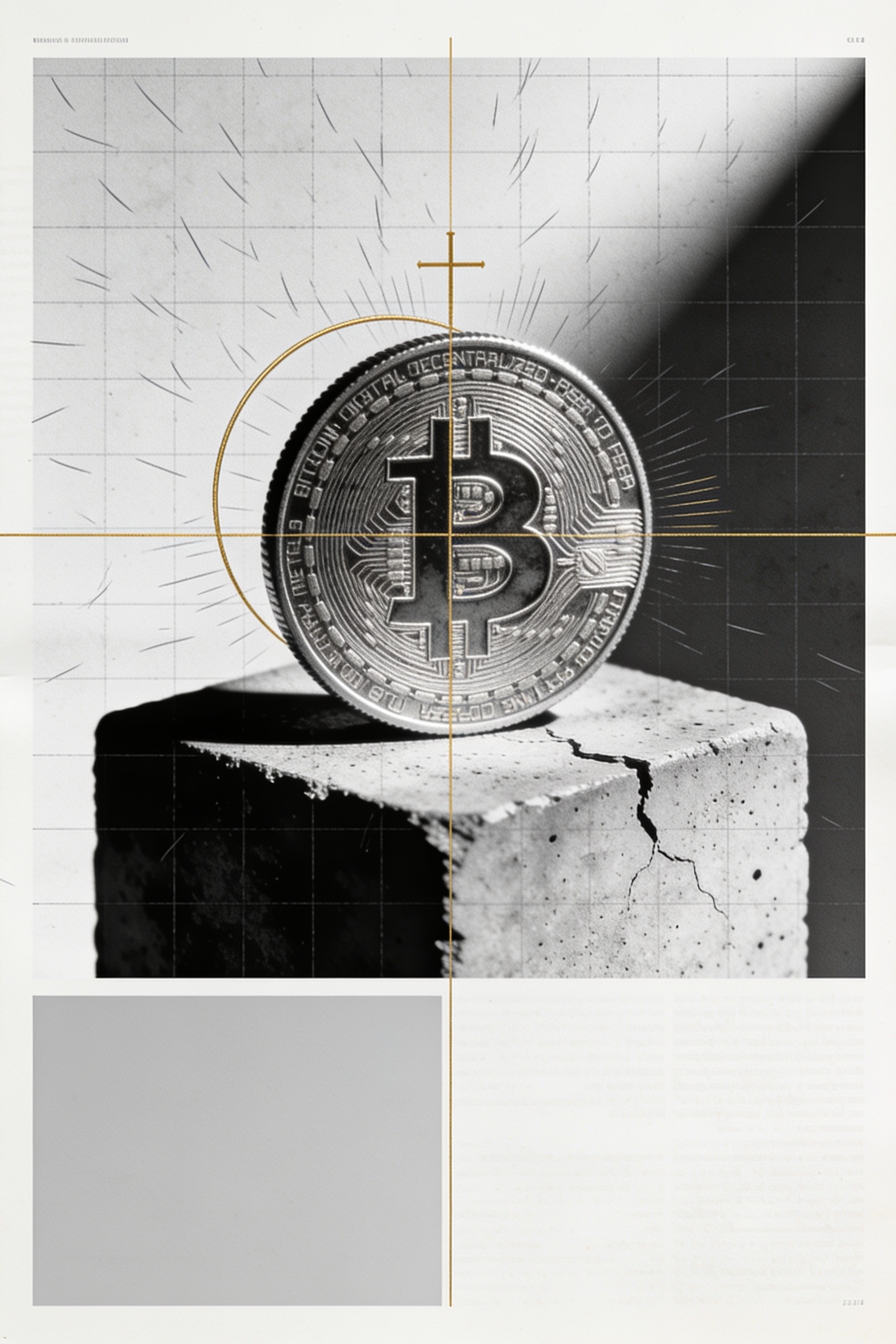
Bitcoin Holds Near Lows As Money Quietly Leaves

Bitcoin is stuck around 74,000 dollars while the cash that fuels crypto keeps draining out. Stablecoin supply, the digital dollars traders use to buy in, fell 14.2 billion dollars in 30 days, the fastest contraction since June 2022.

01What happened

Bitcoin barely moved after a hotter than expected inflation reading on Tuesday, holding steady near 74,000 dollars even as the figure pushed the odds of a U.S. interest rate increase to roughly 90 percent. A rate increase makes borrowing more expensive and typically pulls money away from riskier bets like crypto. Rather than selling off hard, the largest cryptocurrency simply sat out a rebound in stocks, a sign of exhaustion more than panic.

Underneath the flat price, the plumbing looks strained. Outflows from exchange traded funds, the Wall Street products that let ordinary investors hold bitcoin through a brokerage account, extended to a fourth straight day, and forced liquidations of leveraged positions jumped. The analytics firm Glassnode, in a report dated November 11, 2026, warned that capital keeps leaving the market, describing bitcoin as running on empty.

The behavior of traders tells the same story. Glassnode noted that options traders are buying protection against further declines, a hedge known as downside exposure, while prediction markets are assigning increasingly cautious probabilities to a recovery. One counterweight stands out: even as smaller money exits, Glassnode said larger investors are continuing to accumulate.

02What it means · The Griffin Read

The signal here is not price but plumbing.

Bitcoin holds near $74,000 while the stablecoin pool that funds speculation contracts at its fastest pace since 2022 — a $14.2B drain in 30 days. That divergence matters: price is being held up by a smaller, more concentrated base of committed holders, not by expanding capital.

Four days of ETF outflows and rising forced liquidations show leveraged and retail-adjacent money exiting or getting flushed. That bitcoin absorbed a hot CPI print and near-certain rate-hike odds without breaking reads less like strength than exhaustion — the reactive sellers have already left.

The result is a market with thinner shock-absorption, where a future trigger could move price more violently than the current calm suggests. Large holders accumulating into the drain is the classic redistribution pattern, but it rests on interpretive on-chain heuristics, not confirmed fact.