Past issueLatest issue →

No. 6 · 22 November 2026

Controls Trailing the Technology

Lead story · Disclosure01 / 05
Disclosure32.7338° N, 117.1933° WSan Diego International AirportIssue No. 6Status · Reported, not confirmed

Records show military readied to engage drone over San Diego airport

Newly released Federal Aviation Administration files document a September 2026 shutdown that delayed hundreds of flights, with air traffic control audio referencing a possible shootdown of a suspected drone near the runway.

Records show military readied to engage drone over San Diego airport

01What happened

On September 4, 2026, San Diego International Airport was disrupted for long enough to delay hundreds of flights. According to records newly obtained by the research outlet The Black Vault through a Freedom of Information request, the cause was a series of sightings of suspected drones near the airport's runway.

The Federal Aviation Administration released air traffic control recordings and two Mandatory Occurrence Reports, which are the formal filings aviation staff submit when something goes wrong, documenting the sightings. The records indicate the military was prepared to engage the drone, and the air traffic control audio references a possible shootdown over one of the country's busiest commercial fields.

The documents turn an episode that was largely unexplained at the time into a traceable public record. They show how close authorities came to weighing an armed response in airspace shared with passenger jets, and how much of that deliberation only surfaces when files are pried loose through records requests rather than disclosed up front.

02What it means · The Griffin Read

The military stood ready to engage a drone over San Diego's airport. Only a records request revealed it.

On September 4, 2026, San Diego's airport shut down for hours. Pilots reported a drone near the runway. FAA records confirm the Navy was ready to engage. The audio's line about shooting it down is not confirmed.

The Navy, the FAA, and TSA said nothing at the time. The facts came out on November 3. The outlet The Black Vault got them by request. Nobody ever named the drone's operator.

This is the airport's second drone scare this year. In April, a United jet reported a possible drone, also unresolved. A bill on airport drone response has sat in Congress since 2025.

Each agency guards its story before telling the public. The Navy has not said if it was ready to fire. A threat kept secret cannot scare off the next drone.
MONEY
Money — Crypto37.5665° N, 126.9780° ESeoulIssue No. 6Status · Reported, not confirmed

Korean exchanges freeze a token after suspected bridge hack

South Korea's two largest crypto exchanges halted transfers of the CYBER token after its issuer reported a suspected bridge exploit worth about one million dollars.

Korean exchanges freeze a token after suspected bridge hack

01What happened

Cyber, the company behind the CYBER token, said it was investigating after an unexpected batch of CYBER tokens was created, or minted, on the Solana blockchain. Shortly after, tokens began moving out of the lockbox on the Ethereum network where the project holds collateral. A bridge is the software that lets a single token move between different blockchains, and the lockbox is meant to hold one real token for every copy issued elsewhere. Creating extra tokens on one chain and draining the backing on another is the signature of a bridge exploit, and Cyber put the suspected loss at roughly one million dollars.

In response, the South Korean exchanges Upbit and Bithumb both suspended CYBER deposits and withdrawals, citing a suspected security incident. Bithumb kept trading open even as it blocked transfers in and out, meaning customers could still buy and sell but could not move tokens off the platform. Separately, the exchange Kraken warned that CYBER deposits sent through the Optimism network, another chain linked to the token, could face delays.

Freezing transfers is the standard defensive move when an exchange fears that stolen or fraudulently minted tokens could be deposited and cashed out. By locking the doors while an investigation runs, the exchanges limit the attacker's ability to turn exploited tokens into money, at the cost of trapping ordinary holders until the all-clear.

02What it means · The Griffin Read

Korea's two biggest exchanges froze a token called CYBER. A suspected bridge hack drained about $968,000 from it.

Cyber says someone minted extra CYBER coins on Solana. They then drained the real coins backing those copies on Ethereum. That took about $968,000. Upbit and Bithumb froze CYBER deposits and withdrawals. Bithumb kept trading open but blocked moving coins off the platform.

A bridge lets one coin exist on many blockchains. One vault holds one real coin for every copy made elsewhere. When that vault leaks, every copy turns suspect at once. The same freeze hit another token, SAND, in August after a similar attack.

Holders can still trade CYBER but cannot move it off the exchange. The price dipped 8%, then recovered.

Korea plans to let exchanges freeze on suspicion; these exchanges used existing law. Cyber hasn't said what broke or how much was lost.

THE WORLD
The World — Tech & power37.3541° N, 121.9552° WSanta ClaraIssue No. 6Status · Reported, not confirmed

Washington and California press Nvidia on China chip sales

US Treasury Secretary Scott Bessent says regulators want answers on how Nvidia sold advanced chips to China, while California has opened a criminal probe into the same sales.

Washington and California press Nvidia on China chip sales

01What happened

US Treasury Secretary Scott Bessent said on Sunday that the government is seeking answers from Nvidia, the leading maker of the chips that power artificial intelligence, over its chip sales to China. Bessent said officials have been in touch with the company's temporary management, lead directors and lawyers, and want to know who ran compliance, the internal function meant to keep a company inside the law. He said it behoves Nvidia to move quickly because regulators want to understand the company's culture. Bessent referred to Nvidia as the firm formerly led by Jensen Huang, who he said resigned following an affair with a suspected Chinese spy.

The pressure is not confined to Washington. California Attorney General Rob Bonta told Bloomberg News on Friday that the state is investigating whether Nvidia illegally sold advanced chips to China and misled investors about those sales. Bonta said the inquiry is examining potential criminal violations of a range of state laws. Together, the federal and state actions put a single company at the centre of the long-running effort to keep the most powerful computing hardware out of Chinese hands, a policy enforced through export controls that restrict which chips American firms may ship abroad.

02What it means · The Griffin Read

Export-control enforcement now hinges on one company's compliance culture.

The reaction

A selloff tied to leadership upheaval shows markets already pricing legal and governance risk, not a change in Nvidia's commercial dominance. Revenue kept climbing even as its legal standing eroded.

Structural risk

Almost the entire US strategy to deny China advanced AI compute runs through compliance decisions inside a single firm. Parallel federal, state criminal, and SEC inquiries expose that the control regime has no independent verification backstop.

The pressure

Treasury naming directors and counsel, plus a California criminal probe into investor disclosures, converts policy into a demand for corporate accountability. Duplication of civil and criminal fronts constrains Nvidia regardless of eventual findings.

What to do

Treat enforcement interest as real and commercial dependence as unbroken. Watch whether probes produce charges or stall into perceived overreach.

THE WORLD
The World — The margin38.8977° N, 77.0365° WWashington, D.C.Issue No. 6Status · Reported, not confirmed

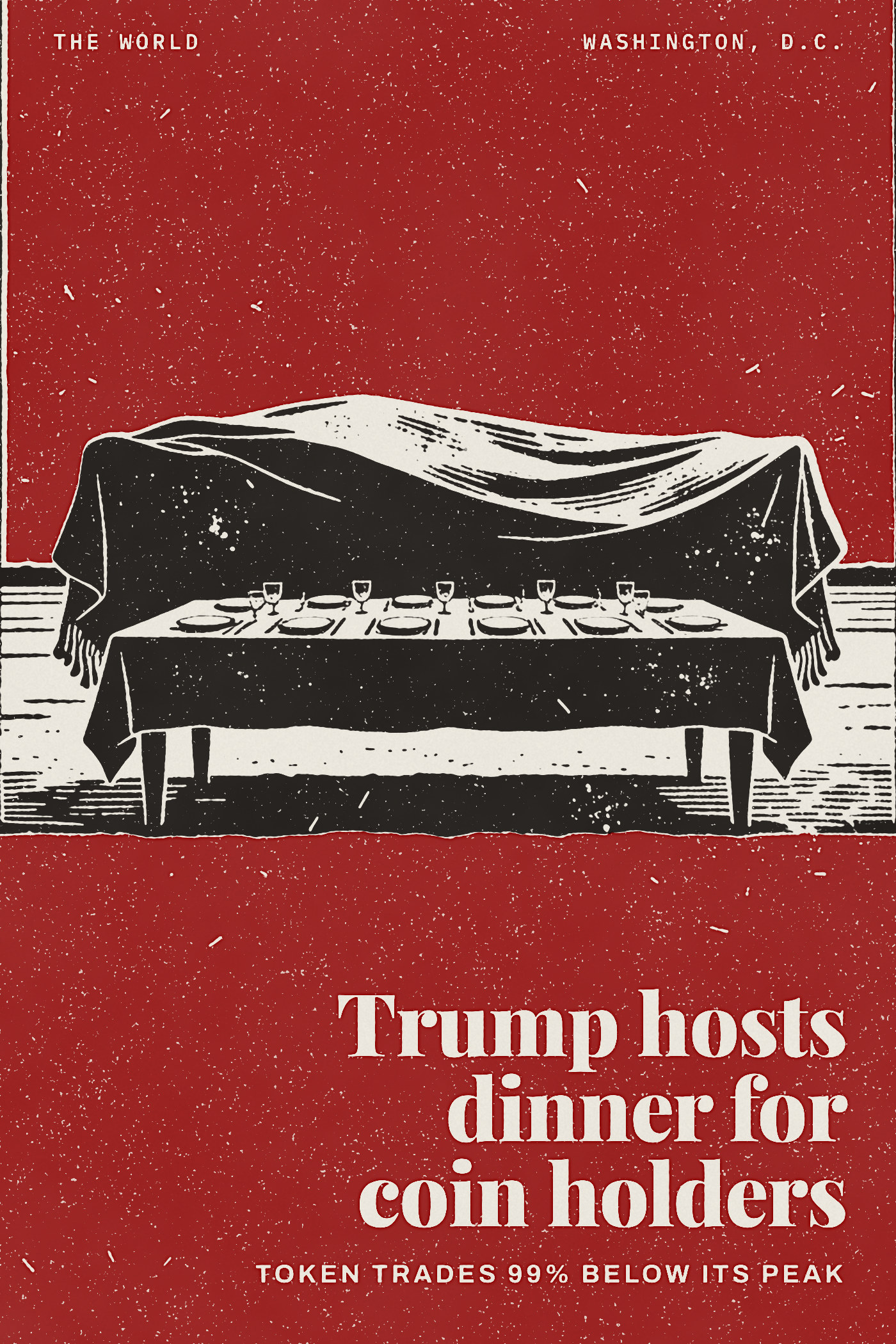
Trump hosts another private dinner for his coin's biggest buyers

The president is convening the largest holders of his meme coin for a private event, even as the token trades 99 percent below its peak.

Trump hosts another private dinner for his coin's biggest buyers

01What happened

President Donald Trump is hosting a private dinner for the largest owners of his meme coin, the digital token launched shortly before his inauguration. According to the reporting, the guest list includes boxer Floyd Mayweather, the investor Kevin O'Leary, and NBA champion Tristan Thompson. A meme coin is a cryptocurrency whose value rests almost entirely on hype and attention rather than any underlying business or cash flow.

The gatherings tie access to a sitting president directly to how much of his coin a person holds, a structure that collapses the usual wall between public office and private enrichment. Buyers who accumulate the token effectively bid for a seat near the president, turning a speculative asset into a ticket.

02How markets reacted

−99%
TRUMP meme coindown from its peak price

The economics for those buyers have been punishing. The token now trades roughly 99 percent below its peak, meaning someone who bought at the top has lost almost the entire value of that position. The dinners continue even as the price sits near the bottom of its range.

03What it means · The Griffin Read

Trump hosted his third coin-holder dinner this week. His coin trades near 99% below its peak.

This week Trump held his third coin dinner. The guest list shrank from 220 buyers to 130. A seat once cost $55,000 in tokens; now $518 was enough.

The coin peaked at $73 two days after its 2025 launch. It now trades near $0.89, down almost 99%. Most of the supply went to Trump-linked companies first.

Buyers who bought at the peak lost almost everything. The family's reported crypto earnings top $635 million. The biggest holder, Justin Sun, is suing Trump's other crypto venture. The SEC dropped its case against him after Trump took office.

No watchdog has stopped this. No ethics office has said whether it reviewed the dinner, and Congress gains subpoena power only in January. Democrats say buyers are paying for a seat near the president.

INTELLIGENCE
Intelligence — AI37.3349° N, 122.0090° WCupertinoIssue No. 6Status · Reported, not confirmed

Apple moves to build its own AI agent

A now-removed job listing shows Apple is recruiting an engineer to lead work on an AI agent that can browse the web, control apps, write code and call services.

Apple moves to build its own AI agent

01What happened

Apple is working on its own artificial-intelligence agent, software designed to carry out multi-step tasks on a person's behalf rather than simply answer questions. According to a job listing spotted by Bloomberg and later removed, the company is hiring an engineer to lead the creation of what it calls an agentic AI, able to browse websites, work across different apps, write code and call outside services. The posting is the clearest sign yet that Apple intends to compete directly in a field dominated so far by dedicated AI labs.

The stakes go beyond one more chatbot. As trade publication Digitimes notes, frontier models are becoming capable of controlling apps and executing tasks, and the company that controls the operating system may ultimately decide how much freedom those agents are given. For Apple, which controls the iPhone and Mac operating systems, that means a built-in advantage: it can set the rules for what any agent, its own or a rival's, is permitted to do on its devices.

That turns operating-system access into the next competitive fault line in the agent market. An agent is only as useful as the apps and services it can reach, and on Apple hardware Apple decides that reach. Owning both the agent and the platform it runs on could let the company shape the terms on which outside AI systems operate inside its ecosystem.

02What it means · The Griffin Read

Apple is building its own AI agent. It also makes rival agents harder to use on its devices.

A leaked job ad shows Apple is building its own AI agent. The agent would browse the web, run apps, write code, and call outside tools.

Apple already controls how much access any agent gets on its phones. Turning on ChatGPT's computer-use feature now takes 14 steps, up from four.

Apple's own agent is not built yet, and has no release date. An EU court rejected Apple's bid to escape rules that force it to open its phones to rivals. A separate app-store case reaches the US Supreme Court in January.

US courts have not ruled on Apple's app rules. Apple's extra steps make rival agents harder to use.