Past issueLatest issue →

No. 7 · 23 November 2026

The Lines No Longer Hold

Lead story · Disclosure01 / 08
Disclosure32.7338° N, 117.1933° WSan Diego International AirportIssue No. 7Status · Reported, not confirmed

Records Show Military Weighed Shooting Down San Diego Drone

Newly released Federal Aviation Administration records document a September 2026 drone scare that delayed hundreds of flights at San Diego International Airport, with air traffic control audio referencing a possible shootdown.

Records Show Military Weighed Shooting Down San Diego Drone

01What happened

On September 4, 2026, operations at San Diego International Airport were disrupted by sightings of suspected drones near the airport's runway, delaying hundreds of flights. The episode is now documented in Federal Aviation Administration records obtained by The Black Vault, a website that publishes government files released under the Freedom of Information Act, the law that lets the public request records from federal agencies.

The release includes air traffic control recordings and two Mandatory Occurrence Reports, which are the formal filings controllers and operators submit when something goes wrong in managed airspace. According to the records, the military was prepared to engage the drone, and the air traffic control audio references a possible shootdown over or near a major civilian airport.

The documents do not resolve what the objects were or who, if anyone, was flying them. They show instead how a routine day of commercial flights collided with an airspace threat serious enough that armed response was on the table, and how long it took for an official account to reach the public.

02What it means · The Griffin Read

A drone near San Diego's airport delayed 420 flights. Navy crews stood ready to engage it.

Controllers tracked the drone near the runway on September 4. The ground stop ran from 2 p.m. to 4:30 p.m., delaying about 420 flights.

Records later showed sailors at Naval Air Station North Island, a nearby base, prepared to engage the drone. Control-tower audio mentioned a possible shootdown.

Congress gave agencies new power in December 2025 to stop drone threats near bases and airports. That power followed a wave of drone sightings over military sites in 2024. The public only learned of the Navy's readiness two months later, through a public records request.

The Navy acted to guard its own base first, not the airport's traffic. That same emergency power now feeds a bill to lock counter-drone authority in place through 2030.
THE WORLD
The World — Conflicts32.1167° N, 20.0686° EBenghazi naval baseIssue No. 7Status · Reported, not confirmed

Ukraine says it sank a Russian warship off Libya

President Volodymyr Zelensky said Ukrainian forces used seven naval drones to sink the corvette Merkury, one of Russia's newest ships, near the coast of Libya. It marks a strike far beyond the usual Black Sea theatre.

Ukraine says it sank a Russian warship off Libya

01What happened

Zelensky said on Monday that Ukraine's forces sank the Russian corvette Merkury, a vessel commissioned in 2023, near the coast of Libya in what he called an exemplary sea drone operation. A naval drone, in this case, is an uncrewed boat packed with explosives and steered remotely to ram or detonate against a target. Ukraine said seven of its domestically made drones were used, and that a cargo ship was also hit. Libya's eastern government said the sunken warship had stopped for fuel and supplies on its way back to Russia.

The strike is notable for its distance. Most of Ukraine's naval drone campaign has played out in the Black Sea, close to home waters; a successful hit off the North African coast suggests a far longer operational reach. Russia's navy has already lost or been forced to relocate much of its Black Sea fleet under sustained drone and missile pressure, and losing a ship commissioned only two years ago would be a fresh blow to a force Moscow has tried to present as modernising.

The maritime claim came the same day Russia's war on Ukrainian soil continued. The death toll from a Russian attack on the town of Dymer in the Kyiv region rose to 11 after rescuers pulled another body from the rubble, regional governor Tymur Tkachenko said. In Sumy Oblast, emergency crews extinguished a fire after a Russian fibre-optic drone, a type guided by a physical cable that resists jamming, struck a vehicle carrying bread.

02What it means · The Griffin Read

Ukraine proved its naval drones can hunt Russian ships anywhere.

The reach

A strike at Benghazi, not the Black Sea, is the point: Ukraine has shown cheap uncrewed boats can reach a Mediterranean port Moscow treated as rear-area safe. That erases the assumption that Russian vessels are secure once they clear home waters.

The target

The hit landed on a logistics chain, not just a warship — an escorting corvette and a cargo vessel moving military supplies through a Haftar-aligned port. Russia's reliance on third-country docks is now a distributed vulnerability.

The limit

None of this relieves Ukrainian towns: the same day killed eleven in Dymer and torched a bread truck in Sumy. Russia still owns the grinding, civilian-facing side of this war.

For operators

Expect higher force-protection and war-risk pricing around Russia-linked Mediterranean and Baltic shipping, and repeat strikes testing whether this is repeatable.

THE WORLD
The World — Tech & power36.8969° N, 30.7133° EAntalyaIssue No. 7Status · Reported, not confirmed

United Nations climate summit collapses without a deal

The longest climate negotiations in United Nations history ended in Turkey with no agreement. Countries deadlocked over whether the final text should name fossil fuels at all.

United Nations climate summit collapses without a deal

01What happened

The COP31 summit in Antalya, Turkey, became the longest-running set of climate talks in United Nations history before ending with no deal. COP31 is the annual conference where governments meet to coordinate their response to climate change, and its decisions normally require consensus, meaning every country has to agree. This year that bar proved impossible to clear, and negotiators went home empty-handed as deep divisions were laid bare.

The breaking point came over fossil fuels. European Union member states, speaking through the bloc's presidency, refused to adopt an eleventh-hour agreement that left out any explicit mention of coal, oil and gas. That omission had been a central point of contention throughout a summit held against a backdrop of soaring energy prices and wider geopolitical tensions. Australia, which co-hosted the conference, saw its prime minister attribute the failure to what he called difficult geopolitical times.

The collapse has reopened a long-running argument about whether the consensus requirement itself should be reformed, since a single bloc of objectors can now halt an entire agreement. It also lands at a moment of shrinking ambition on money: an analysis by Carbon Brief found that the public funding pledged to help developing countries tackle climate change has fallen by more than seventy per cent compared with earlier commitments.

02What it means · The Griffin Read

The UN's climate summit in Turkey ended with no deal. It was the longest climate talks on record.

Nearly 200 countries met in Antalya, Turkey. The fight was over naming coal, oil and gas. Saudi Arabia and Russia wanted it gone. China and India agreed. The European Union refused and walked out.

COP decisions need every country to agree, a rule called consensus. One bloc can block the whole deal. Three years ago a summit first named fossil fuels. This year it vanished, and talks became the longest ever.

Aid for poorer nations shrank too. Pledges have fallen more than seventy percent from earlier promises. Island states like Vanuatu objected, but could not stop it.

Saudi Arabia and Russia lose nothing by waiting; no deal keeps fossil fuels untouched. The European Union and island states needed a deal. Time favored the oil producers instead.

MONEY
Money — Crypto38.8977° N, 77.0365° WWashington, D.C.Issue No. 7Status · Reported, not confirmed

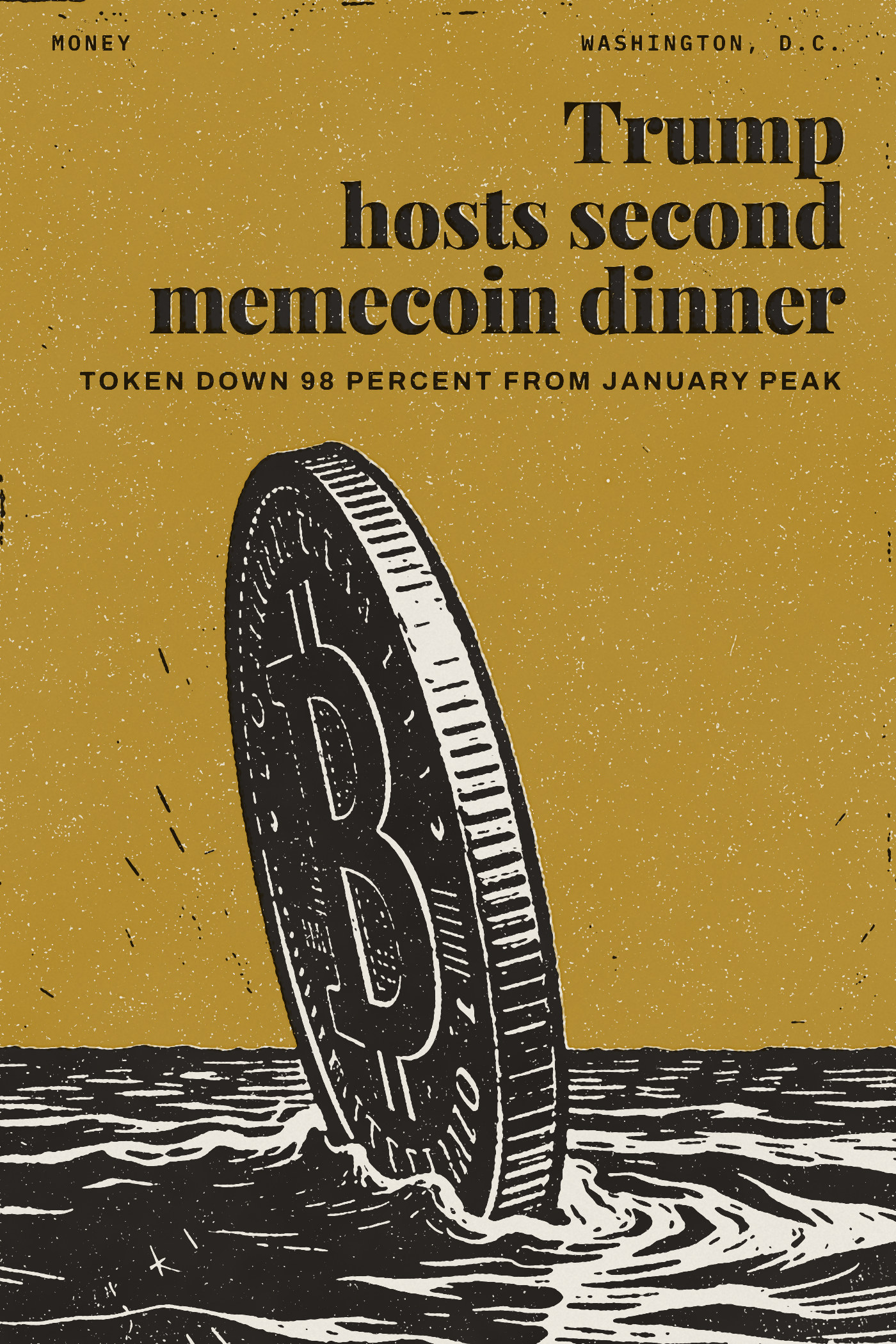
Trump hosts a second dinner for his memecoin's biggest holders

The president rewarded the largest holders of the TRUMP memecoin with gold watches and a seat at dinner, even as the token trades about 98 percent below its January peak. A watchdog group found that half the qualifying wallets were funded through exchanges that bar United States users.

Trump hosts a second dinner for his memecoin's biggest holders

01What happened

President Donald Trump on Sunday night hosted his second dinner for the biggest holders of TRUMP, a so-called memecoin tied to his name. A memecoin is a cryptocurrency with no underlying business, whose value rests almost entirely on hype and the identity attached to it. Four of the top holders, known in crypto slang as whales, were set to leave with 18-karat gold watches, and the guest list included boxer Floyd Mayweather, Shark Tank investor Kevin O'Leary and basketball champion Tristan Thompson.

The event has drawn scrutiny over who actually earned those seats. The advocacy group Public Citizen traced 66 of the 130 qualifying wallets to cryptocurrency exchanges that restrict or bar United States users, raising the question of how many attendees were foreign. That matters because a sitting president profiting from a token held heavily by overseas buyers invites concern about who is paying for access.

02How markets reacted

−98.8%
TRUMP memecoin pricenear 90 cents, below January peak

The dinner came as the token itself has collapsed. TRUMP traded near 90 cents on Sunday, roughly 98.8 percent below the peak it reached shortly after its January 2025 launch. In human terms, a holder who bought at the top and held on has lost almost all of their money, even as the people who created and promoted the coin continue to benefit from trading fees and the attention each event generates.

03What it means · The Griffin Read

Trump's own crypto coin has crashed 98%. He still just threw a gold-watch dinner for its biggest holders.

On Sunday, Trump hosted his second dinner for holders of TRUMP, a coin with no business behind it, just his name. Four got gold watches. A watchdog traced 66 of 130 qualifying wallets to exchanges that bar U.S. buyers.

TRUMP launched in January 2025. It now trades near 90 cents, down 98.8% from its peak of $73. The first dinner drew $148 million; this one drew $8.6 million.

Trump's crypto ventures brought him near $3 billion since taking office, mostly from fees and sales, not coin price. That income flows whether TRUMP rises or falls.

Senate Democrats demanding an investigation lack control of Congress until January. A prosecutor already warned senators against digging further. The crypto regulator settled gently with Trump's biggest backer. No one with power is moving against him yet.

THE WORLD
The World — Tech & power38.9072° N, 77.0369° WWashington, D.C.Issue No. 7Status · Reported, not confirmed

Chinese ministry contact shadowed affair with Nvidia chief

Alice Huang, the woman at the center of a recent Nvidia scandal, stayed in touch with an officer of China's top spy agency for more than a year while involved with the chip company's chief executive, according to the New York Times.

Chinese ministry contact shadowed affair with Nvidia chief

01What happened

Alice Huang, described as the Chinese woman at the heart of Nvidia's recent scandal, kept in contact with an official from China's Ministry of State Security, the country's top intelligence agency, for more than a year during an affair with Jensen Huang, the New York Times reported on Sunday. The Ministry of State Security is the agency that runs China's civilian spying and counterintelligence operations. Reuters and other outlets relayed the account from Washington.

According to the reporting, she was in touch with the ministry officer from the spring of 2025 until the autumn of 2026, and United States officials tracked those contacts during the relationship. The detail places a sitting intelligence service in proximity to the leadership of the company whose chips sit at the center of the US and China technology rivalry.

Spokespeople for Nvidia, Jensen Huang and the Chinese Embassy in Washington did not immediately respond to requests for comment. The excerpts do not establish what, if anything, passed between the parties, only that the contacts were reported and monitored.

02What it means · The Griffin Read

The New York Times reports a Chinese spy agency tracked Jensen Huang's lover. Nvidia reinstated him anyway.

Alice Huang had an affair with Nvidia chief Jensen Huang. US intelligence tracked her contact with a Chinese spy officer from spring 2025 to autumn 2026, the New York Times reports.

Federal agents warned lawmakers in late 2025 that Huang looked like such a target.

Nvidia's stock jumped 29% before Monday's open. Huang resigned as CEO on November 12. The board reinstated him ten days later, backed by President Trump.

A scandal only sinks a leader when his backers want him gone. Huang's backers still need him, so the affair cost him little. The reporting shows monitored contact and an affair, not any transfer. The next test comes on December 1, at a closed hearing.

INTELLIGENCE
Intelligence — Compute37.3707° N, 121.9663° WSanta ClaraIssue No. 7Status · Reported, not confirmed

Nvidia Board's Trust Concerns Preceded Huang Exit

WIRED reports the Nvidia board's central worry before Jensen Huang's resignation was a lack of candor, as President Trump publicly urges the company to bring him back.

Nvidia Board's Trust Concerns Preceded Huang Exit

01What happened

Jensen Huang has resigned as chief executive of Nvidia, the chipmaker whose processors sit at the center of the artificial intelligence boom. According to sources who spoke to WIRED, the board's main concern ahead of his departure was not the swirl of personal allegations against him, including claimed affairs with a direct report and with a person described as an alleged Chinese intelligence asset, but what the board called a lack of candor. In plain terms, directors were alarmed by what they saw as his lying.

President Donald Trump has already weighed in, posting on his Truth Social platform that Nvidia should rehire Huang, arguing that bringing him back would benefit both the company and the United States. The intervention underscores how far Huang's standing had extended beyond the chip business and into national questions about American technology leadership.

Huang was also one of the most visible champions of robotics, repeatedly framing physical machines as the next frontier for Nvidia's chips. His exit leaves that industry without its loudest advocate, and raises the question, posed by trade outlet The Robot Report, of whether the momentum he helped build can continue without him.

02What it means · The Griffin Read

Nvidia's board fired, then rehired, its CEO in eleven days.

The board said personal behavior and a lack of candor broke trust. One source said the lying mattered most. He resigned on November 11. Eleven days later the board reinstated him.

Nvidia stock fell 14% the day he left. It jumped 27% when he returned. Trump pushed for the reversal. The board cites word from U.S. officials that it poses no security risk.

Shareholders asked the board to wait before naming a permanent chief. Congress still wants Huang to testify in December. The board's inquiry into whether he was targeted by foreign spies continues.

The facts about Huang stayed the same. What changed was who still needed him. A president wanted him running Nvidia. So did major shareholders. So did a robotics industry built on his name. A board only removes a leader while the people who matter want it.

THE WORLD
The World — The margin36.8969° N, 30.7133° EAntalyaIssue No. 7Status · Reported, not confirmed

Climate summit in Turkey collapses, splitting Australia

United Nations climate talks in Antalya ended without agreement, and within a day critics were calling for the Australian minister who co-led them to resign.

Climate summit in Turkey collapses, splitting Australia

01What happened

The latest round of United Nations climate negotiations, known as COP31, ended in failure in the Turkish city of Antalya. Turkey hosted the talks but shared leadership of them with Australia, an arrangement that is now at the centre of the recriminations. On Monday the search for someone to blame began in earnest, with public calls in Australia for the resignation of the minister who had been leading the negotiations on the country's behalf.

The sharpest reaction came from the Pacific island nations, the low-lying states most exposed to rising seas and the most immediately threatened by a warming planet. According to the reporting, those countries expressed despair at the inability of the assembled governments to agree on collective action to address global warming. For them the collapse is not a procedural setback but a question of long-term survival.

The episode underscores how fragile these annual gatherings have become. A summit meant to coordinate a global response instead produced finger pointing between the two governments that were supposed to steer it, and no agreement to show for the effort.

02What it means · The Griffin Read

A global climate summit in Turkey collapsed with no deal. One rule let oil states block it.

The final text named no fossil fuels. A week earlier it named them six times. Saudi Arabia, Russia and India blocked that language, saying it threatened their economies. The EU, UK, Panama and the Marshall Islands said no to the weak text. Turkey's minister then declared no deal.

Australia spent 150 million Australian dollars running the talks. Pacific nations like Tuvalu and the Marshall Islands leave with nothing new. Opposition leader Angus Taylor wants Chris Bowen, Australia's climate minister, to resign.

The consensus rule favors the strongest, not the weakest. All countries must agree, or nothing passes. Saudi Arabia, Russia and India pay no price for blocking. They can simply wait out any deadline. Bowen takes the blame. His job rests with Prime Minister Anthony Albanese, who has defended him.

MONEY
Money — Payments37.3861° N, 122.0839° WMountain ViewIssue No. 7Status · Reported, not confirmed

Google Wallet arrives on the iPhone

Google is putting its digital wallet onto Apple's handsets, a direct challenge inside the phone where Apple Pay has long reigned. Apple, meanwhile, named a new leader for its own payments business.

Google Wallet arrives on the iPhone

01What happened

Google has brought Google Wallet, the app that stores payment cards and lets a phone tap to pay, to Apple's iPhone. Until now that ground belonged almost entirely to Apple Pay, Apple's built-in system for the same job. Letting a rival wallet onto the iPhone matters to banks and merchants because it widens who controls the moment a customer pays and whose software sits between them and the card networks.

Apple made its own move the same day, installing a new leader over Apple Pay. The timing underlines how contested the business of moving money through a phone has become, with the two companies that make the world's dominant mobile operating systems now competing directly on the same device.

The announcements landed amid a week dominated by spending on artificial intelligence across Big Tech. Separately, Google reshaped its search homepage to foreground AI chat tools and its conversation history, trimming away even the old search button.

02What it means · The Griffin Read

Google's wallet app landed on iPhones. It still can't tap to pay in stores.

Google Wallet now sits on the iPhone. It still lacks NFC, the chip phones use to tap and pay in stores.

Apple Pay handled 10.5% of U.S. in-store card purchases this year, up from 8.9% in 2024. Europe forced Apple to open that same chip to rivals in 2024.

The same day, Apple named Corey Fugman to run Apple Pay, keeping control in-house. Real tap-to-pay power needs a paid deal with Apple, which nobody has made.

Britain's regulator closed its Apple review but set no ruling date, and has no plan for Google. Until a regulator forces the chip open, Apple keeps the feature that moves money.