Past issueLatest issue →

No. 8 · 24 November 2026

Control at the Chokepoint

Lead story · Money01 / 12
Money — Crypto38.8977° N, 77.0365° WWashington, D.C.Issue No. 8Status · Reported, not confirmed

North Korea launders Binance hack loot through mixers

Blockchain analysts say hackers pushed 247 million dollars of stolen crypto through mixing services, while US prosecutors move to claw back 1.17 billion dollars tied to the same breach.

North Korea launders Binance hack loot through mixers

01What happened

Roughly a month after a hack that drained about 6.4 billion dollars from Binance, the crypto exchange, blockchain analysis firm Elliptic says attackers linked to North Korea have moved around 247 million dollars through Bitcoin mixers. A mixer, or coinjoin, pools many users' coins into one bundled transaction so investigators cannot trace which money went where. Elliptic found nearly all of that mixing was coordinated by a single entity it calls Kruw, operating during fixed daily hours, a pattern it reads as possible handoffs to China-based money launderers.

Separately, the US Justice Department is seeking to recover about 1.17 billion dollars in USDC, a dollar-pegged stablecoin issued by Circle, that prosecutors tie to the October 29 breach. Because stablecoin issuers can freeze and reissue tokens, Circle could in principle cancel the stolen coins and mint replacements, giving authorities a path to recover value that ordinary Bitcoin does not offer. Elliptic notes that the operator behind the mixing refuses to block funds like these, underscoring the gap between frozen stablecoins and harder-to-touch Bitcoin.

The split outcome shows the two-track reality of stolen crypto. Centralized, freezable assets like USDC can be chased through the courts and the issuer, while coins run through mixers slip toward laundering networks that investigators believe reach into China.

02What it means · The Griffin Read

Hackers moved $247 million through Bitcoin mixers. Prosecutors seek $1.17 billion in frozen stablecoins.

The $247 million came from North Korea's $6.4 billion Binance theft. Prosecutors want $1.17 billion in USDC back from the same heist.

Circle, the company behind USDC, can freeze stolen tokens and mint new ones. Bitcoin has no company, so mixing leaves nothing to freeze.

Investigators have frozen 44% of the stolen funds, far above the 3% recovered after a 2025 hack. That progress comes from tokens run by one company, not Bitcoin.

The mixer operator, Kruw, refuses to block stolen funds. Treasury sanctioned a similar mixer in 2023 but has not named Kruw yet. Mixed coins keep moving toward buyers abroad.

USDC lives inside Circle's books, so Circle can always claw it back. Bitcoin lives on a network no company controls, so no one can pressure it. That gap decides which coins come home.


THE WORLD
The World — Conflicts32.1167° N, 20.0667° EBenghaziIssue No. 8

Ukraine strikes Russian warships far beyond the Black Sea

Ukrainian sea drones destroyed a Russian corvette at Benghazi in Libya and hit cargo ships in the Mediterranean and Baltic, all within a single day.

Ukraine strikes Russian warships far beyond the Black Sea

01What happened

Ukraine has pushed its war on Russia's navy well outside the Black Sea, the body of water where the two countries have fought since 2022. According to defense outlet TWZ, Ukraine destroyed a new Russian corvette, a small fast warship, at the port of Benghazi in Libya, and struck two other cargo ships on the same day, one in the Mediterranean Sea and one in the Baltic Sea. The BBC's Frank Gardner writes that sinking a Russian warship at a port in Libya raises the stakes of the war a notch.

Analysts are examining how Kyiv reached targets so far from home. TWZ reports speculation that Ukraine used a clandestine mothership, a vessel that carries and launches smaller uncrewed sea drones, to deliver the attack on Russian ships in Benghazi. Such a capability would let Ukraine expand strikes on Russian shipping thousands of miles from its own coastline, turning distant ports into contested waters.

The campaign unfolds as Russia keeps hitting Ukrainian cities. In Zaporizhzhia, a southern Ukrainian city, overnight Russian strikes killed two people and wounded about 40 others, four of them children, regional governor Mykhailo Semikin said. The pattern underscores how both sides are widening the geography of the war rather than narrowing it.

02What it means · The Griffin Read

Ukrainian drones hit a Russian warship in Libya, far from Ukraine's coast. Peace talks near a January deadline.

Ukraine's drones hit a Russian warship at a Libyan port, and a Mediterranean cargo ship, on November 22. The Baltic ship was hit a day earlier. President Zelensky said the strikes show Russia's navy is not safe anywhere.

The war on Russia's navy began in the Black Sea in 2022. It spread to Russian oil ships in the Mediterranean last December, and now reaches Libya, far from Ukraine's coast.

Overnight, Russian missiles killed two people in a Ukrainian city and wounded about 40. The United States has backed Ukraine's earlier strikes on Russian oil ships, but not this warship attack.

Peace talks aim for a deal before January 2027. Ukraine's drones are cheap and many; Russia's warships are costly and few. Hitting ships now raises the price of waiting.

THE WORLD
The World — Tech & power40.7141° N, 74.0060° WNew York Supreme Court, ManhattanIssue No. 8Status · Reported, not confirmed

Kalshi Wins Reprieve in New York, Retreats in Utah

A New York judge declined to shut down the prediction-market platform Kalshi on Monday, even as the company suspended operations in Utah after a federal judge there let the state enforce its gambling laws.

Kalshi Wins Reprieve in New York, Retreats in Utah

01What happened

Kalshi runs a marketplace where people buy and sell event contracts, which are bets on yes-or-no questions about future outcomes such as sports results. The company argues these contracts are financial instruments overseen federally by the Commodity Futures Trading Commission, the agency that polices derivatives trading, and that individual states therefore cannot treat them as illegal gambling. A growing number of states disagree, setting up a fight over who gets to regulate the product.

In New York, Judge Melissa Crane declined at a hearing on Monday to block Kalshi from operating in the state for now, instead asking both sides to present their full arguments on an expedited basis ahead of a January hearing. The reprieve lets Kalshi keep offering its sports-related contracts to New York users while the case proceeds. The outcome was different in Utah, where a federal judge allowed the state to enforce its gambling laws, prompting Kalshi to suspend operations there rather than risk running afoul of the ban.

The split rulings leave Kalshi operating under a patchwork of state-by-state decisions, with each court weighing whether federal oversight of event contracts overrides local gambling statutes.

02What it means · The Griffin Read

A New York judge let Kalshi keep operating. Kalshi quit Utah the same week.

Kalshi runs a market for bets on events. A New York judge refused to shut it down. A Utah judge let that state enforce its gambling ban, so Kalshi quit Utah.

Kalshi is worth 40 billion dollars. It fights over a dozen states on one question. Does federal law beat state gambling law?

States keep winning the real rulings. Kalshi lost in Utah, Maryland, Ohio, Louisiana, Nevada and Washington. Its only win is a preliminary New Jersey ruling under appeal, plus this week's New York pause.

Rival DraftKings, building its own federally watched betting app, has lost half its value this year as Kalshi presses in.

States guard their gambling licenses and fees before any fairness question. Courts have backed that turf in most recent rulings. New York's pause looks like delay, not a win.

INTELLIGENCE
Intelligence — Compute37.3541° N, 121.9552° WSanta ClaraIssue No. 8Status · Reported, not confirmed

Jensen Huang's return to Nvidia ignites a relief rally

Nvidia brought back Jensen Huang as chief executive, and its shares jumped more than 30 percent in a single day. The move calmed global markets even as analysts warned the artificial intelligence boom still looks fragile.

Jensen Huang's return to Nvidia ignites a relief rally

01What happened

Nvidia reinstalled Jensen Huang as chief executive of the artificial intelligence computing company, a surprise move that steadied investors who had grown nervous about the sector. What is at stake is confidence in the whole AI trade. Even with Huang back, some analysts point to the model of circular financing now underwriting the boom, in which AI firms fund and buy from one another, and warn the party cannot last forever. The backdrop is tense: the United States Department of Commerce has just added Singapore-based cloud firm Megaspeed and six Southeast Asian affiliates to its trade blacklist, escalating a federal crackdown on alleged smuggling of Nvidia chips into China. Alibaba disputes being listed as an affiliate. Observers also caution that Huang's return offers no guarantee of relief for Beijing, where Xi Jinping is watching closely.

02How markets reacted

+30%
Nvidia shares, MondayBiggest daily jump on Huang's return

Markets took the news as a reason to buy. Nvidia shares rose more than 30 percent on Monday, and the rally rippled outward, with Taiwan stocks soaring over 9 percent and a broad relief rally sweeping Wall Street and Asia. Cryptocurrency told a different story. Bitcoin slipped below 60,000 dollars early Tuesday before recovering slightly, erasing a brief Nvidia-fueled bounce, as commentator Arthur Hayes argued that a roaring stock market is the worst thing for crypto holdings.

03What it means · The Griffin Read

Nvidia stock jumped 30 percent after Jensen Huang returned as CEO. He had quit only 11 days earlier.

Nvidia's board brought Huang back on Sunday. Days before, it had removed him over an affair with a woman, alleged to spy for China. Shares jumped 31 percent the next trading day.

The swing matched the fall. Nvidia had dropped from a $243 peak to $166, its worst month since 2022. A petition backing Huang drew 176,000 signatures within a week.

The Commerce Department blacklisted Nvidia customer Megaspeed and six partners during the rally. It accused them of smuggling Nvidia chips into China. Alibaba, named as one affiliate, denies the charge.

Huang's return rests on a government assurance that no security law was broken, a claim Congress rejects. He testifies before the Senate on December 3. The rally already lost six percent in one day.

DISCLOSURE
Disclosure32.7336° N, 117.1897° WSan Diego International AirportIssue No. 8Status · Reported, not confirmed

Records Show Military Readied to Fire on Airport Drone

Newly released Federal Aviation Administration records document a September 4, 2026, drone scare that delayed hundreds of flights at San Diego International Airport, with air traffic control audio referencing a possible shootdown.

Records Show Military Readied to Fire on Airport Drone

01What happened

The disruption at San Diego International Airport on September 4, 2026, delayed hundreds of flights and is now documented in records released by the Federal Aviation Administration, the agency that runs United States airspace. The records, obtained by the research outlet The Black Vault through a Freedom of Information request, include air traffic control recordings and two Mandatory Occurrence Reports, which are formal filings describing safety incidents. They describe sightings of suspected drones near one of the airport's runways, and the control tower audio references a possible shootdown of the object.

The San Diego case lands alongside a separate set of security reports describing repeated drone flights over sensitive sites. Those reports, obtained by the outlet Liberation Times, document drone activity over Virginia's Surry Nuclear Power Plant in December 2024, including a flight over both reactor containment buildings, the structures that house the plant's nuclear reactors. The plant sits near Langley Air Force Base. Taken together, the releases show that small unidentified aircraft have repeatedly reached airspace over critical infrastructure, and that officials have at times considered using force in response.

02What it means · The Griffin Read

Drones flew over nuclear reactors and a US airport. No one stopped them.

A drone near a runway delayed 420 flights at San Diego on September 4, 2026. Controllers talked of shooting it down. The drone was never identified.

This is routine now. Bases logged 350 drone incursions in 2024 alone. Drones have flown over Virginia's Surry nuclear plant, once passing both reactor buildings. None were ever identified.

No drone has been named, caught, or shot down. The Nuclear Regulatory Commission closed its Surry drone cases unresolved. A bill letting power plants shoot down drones themselves is still stuck in Congress.

A warning works only if people believe it. Every unidentified flight that goes unanswered tells the next operator the sky stays open.

FRONTIER
Frontier — Space40.9606° N, 100.2983° EJiuquan Satellite Launch CenterIssue No. 8Status · Reported, not confirmed

Pakistani pilot to become first foreigner on China's station

China will fly its first foreign astronaut to the Tiangong space station this week, sending Pakistan Air Force pilot Muhammad Zeeshan Ali for about a week of experiments alongside the Chinese crew.

01What happened

China is preparing to launch a crewed mission on Wednesday that will carry Muhammad Zeeshan Ali, a Pakistan Air Force pilot, to the Tiangong space station. He will be the first foreign astronaut to board Tiangong, the orbiting laboratory that Beijing built and operates on its own after being shut out of the International Space Station. Ali said he would be carrying "the hopes of 250 million Pakistanis" with him.

Ali is set to spend roughly a week aboard the station, conducting experiments together with the Chinese crew. Tiangong, whose name means "heavenly palace," is China's permanently crewed outpost in low Earth orbit, and opening it to a partner country marks a shift from a programme that has so far flown only Chinese nationals.

The flight doubles as a diplomatic gesture. By choosing Pakistan, one of its closest strategic partners, for this first seat, Beijing signals that access to its human spaceflight programme can be extended to allied states, a counterpoint to the United States led coalitions that dominate the International Space Station.

02What it means · The Griffin Read

China launches a Pakistani pilot to its space station Wednesday. He will be the first foreigner ever aboard.

Pilot Muhammad Zeeshan Ali launches Wednesday on Shenzhou-24 and docks with Tiangong hours later. He spends a week running experiments before returning around November 30.

A 2011 law bars NASA from working with China's space program. Since then China landed on the moon's far side and put a rover on Mars. Now it offers allies a seat.

China picked Pakistan, its closest partner, for the first foreign seat. China's agency chose, trained and runs the whole mission. Pakistan supplies the pilot; China keeps command.

Beijing is opening its station to a close ally. China is building a rival to the US-led station group, one ally at a time. Expect the next seat to go to another country China wants pulled from that camp.

THE WORLD
The World — The margin40.7836° N, 91.1550° WIowa Army Ammunition Plant, MiddletownIssue No. 8Status · Reported, not confirmed

Trump halts Army plan to detonate lead explosives in Iowa

The US Army planned to blow up about five tons of unstable lead explosives at an Iowa ammunition plant. After public outcry and a court fight, President Trump stepped in to stop it.

Trump halts Army plan to detonate lead explosives in Iowa

01What happened

The US Army set out to carry out two controlled detonations of lead explosives at an ammunition plant in Iowa, a plan involving roughly five tons of unstable lead azide. When details of the plan surfaced, they drew public outcry and a legal battle over whether the blasts should go ahead. As of Sunday the Army said it would proceed with the detonation on Wednesday.

President Donald Trump then moved to halt the Iowa detonation, saying the state's new governor would be to blame if the material blew up accidentally. Critics argued the Army appeared to be improvising a dangerous operation, pointing to guidance that amounted to telling people to simply rinse off exposure to the lead compound.

The dispute leaves two conflicting signals on the record: an Army intent on detonating the stockpile mid-week, and a presidential intervention aiming to stop it. The core worry raised by opponents is contamination from scattering a large quantity of a toxic lead compound into the surrounding environment.

02What it means · The Griffin Read

Trump says he stopped the Iowa blast. The Army still plans to set it off.

Trump says he halted the Army's plan to blow up five tons of old lead azide in Iowa. He warned the new governor would be blamed if it exploded on its own. But a court already cleared the permit. The Army said Sunday it still plans to detonate it Wednesday.

The stockpile is 68 drums of lead azide. It sat more than 20 years at a plant already listed as a toxic cleanup site.

The Army and its contractor paid just $39,311 in 2024 for mishandling explosives here. That is a small fine for the only operator allowed to run this plant.

Trump's halt needs the new governor's approval. But that governor refused to approve or reject the plan. The court's permit still stands, so the Army still holds the real decision.

LIFE
Life — Bio42.3709° N, 71.1828° WWatertown, MassachusettsIssue No. 8Status · Reported, not confirmed

Kymera's eczema pill clears mid-stage test

Kymera Therapeutics said its experimental daily pill safely eased itchy, inflamed skin in a 244-patient trial, setting up a possible challenge to the leading injected eczema drug.

Kymera's eczema pill clears mid-stage test

01What happened

Kymera Therapeutics announced on Monday that its experimental eczema therapy effectively and safely treated patients' itchy, inflamed skin in a mid-stage study. The trial enrolled 244 patients and tested the drug in Phase 2, the middle of the three stages that human drug testing typically moves through before a company can seek approval. Kymera's candidate is a pill, not an injection, which matters because the current market leader for moderate to severe eczema is given as a shot.

The drug is what scientists call a protein degrader, a medicine designed to tag and destroy a disease-driving protein inside the body rather than simply block it. Wall Street analysts described the results as showing "biologic-like efficacy," meaning the pill appeared to work at a level comparable to the injected biologic drugs that now dominate the field. Those analysts argued the therapy could challenge Dupixent, the top-selling eczema treatment sold by Sanofi and Regeneron.

A Phase 2 success is an early milestone, not an approval, and larger late-stage trials would be needed to confirm both how well the pill works and how safe it is over time. But a convenient daily tablet that matches injected drugs on results would be a meaningful option for patients who want relief without regular shots.

02What it means · The Griffin Read

Kymera's eczema pill looks real, but the Dupixent threat is years away.

The real shift

A daily pill matching injected biologics attacks Dupixent's convenience moat, not just its chemistry. It is the first serious sign that protein degraders, mostly proven in oncology, can compete in chronic immunology.

Structural squeeze

Timing bites: this lands years before Dupixent's 2032 U.S. patent cliff, caught between a more convenient oral rival and looming biosimilars. Sanofi, Regeneron and Lilly's Ebglyss face a compressed window to extract peak value.

Yellow flag

'Biologic-like efficacy' is a sell-side read of one 244-patient trial, and the non-monotonic dose curve — mid-dose outperforming high-dose — complicates Phase 3 dose selection.

What to do

Treat this as proof-of-mechanism, not proven franchise erosion. Incumbents still hold a decade of real-world safety data, payer relationships and prescriber inertia that a young drug class must overcome.

THE WORLD
The World — Tech & power37.5407° N, 77.4360° WRichmondIssue No. 8Status · Reported, not confirmed

Two States Sue Musk Over Grok's Deepfake Images

Oregon and Virginia accuse Elon Musk's companies of running weak safeguards that let the Grok artificial intelligence tool generate sexualized images of real people, including children.

Two States Sue Musk Over Grok's Deepfake Images

01What happened

The attorneys general of Oregon and Virginia filed separate but similar lawsuits on Monday against SpaceX, the Musk-owned company that operates the X social media platform and its built-in artificial intelligence system, Grok. Oregon Attorney General Dan Rayfield and Virginia Attorney General Jay Jones allege the companies violated state consumer protection laws by ignoring what they call industry-standard safeguards against abusive imagery. A consumer protection law bars companies from deceiving the public, and the states argue Musk falsely promoted the platform and its Grok features as safe.

At the center of the case is the claim that Grok can produce sexualized images of identifiable people, including what prosecutors describe as child sexual abuse material and so-called revenge pornography, meaning intimate images shared or created without consent. The Virginia complaint accuses Musk of acting willfully. X counters that every output Grok produces is screened before it reaches a user, but the state attorneys general say the tool is still generating illegal imagery despite those checks.

The suits test whether state consumer protection law can force a company to prove its safety claims about an artificial intelligence product. If the states prevail, the case could set a template for how other attorneys general pursue companies whose image-generation tools can be turned to abuse.

02What it means · The Griffin Read

State AGs are turning consumer law into AI's new enforcement lever.

The move

Oregon and Virginia didn't invent an AI statute — they repurposed consumer-protection law, the same tool used against tobacco and opioids, to attack Grok's safety claims. That matters more than the specific abuse allegations: it bypasses the stalled federal track entirely.

Why it scales

This is low-cost, high-visibility litigation against a maximally unpopular defendant. If these suits survive early motions, expect copycat filings from other AGs and pressure on every image-generator offering permissive or edit-without-consent modes.

The exposure

By folding xAI into SpaceX, Musk tied a toxic content-moderation fight to an aerospace-defense balance sheet. The alleged red-team cuts and stripped NCMEC reports, if surfaced in discovery, reframe this from technical failure to knowing tradeoff.

What to do

Treat permissiveness as a legal liability, not a product edge; price fifty-state litigation risk into any generative-AI exposure.

THE WORLD
The World — Conflicts52.2297° N, 21.0122° EWarsawIssue No. 8

Russian drone crosses into Polish airspace, Warsaw says

Poland's military says a Russian drone briefly entered its airspace overnight during an attack on Ukraine, and a senior defence official called the incursion deliberate.

Russian drone crosses into Polish airspace, Warsaw says

01What happened

A Russian drone briefly crossed into Polish airspace overnight during an attack on neighbouring Ukraine, Poland's military said on Tuesday. Poland is a member of the NATO military alliance, which means that any attack on its territory is treated as a matter of collective defence by its allies. An uncrewed aircraft, or drone, straying across a member's border is the kind of incident that can force the alliance to decide whether it was an accident of war or a test of its resolve.

The country's deputy defence minister said he assumed the incursion was a deliberate act rather than a navigation error or a stray weapon that drifted off course. Poland's Defence Ministry took the same view, saying it believes Russia sent the drone across the Ukrainian border on purpose. The drone was described as briefly entering Polish airspace, and the available accounts do not report that it struck anything or that Polish forces shot it down.

The distinction between accident and intent matters because it shapes how Warsaw and its allies are expected to respond. An accidental spillover from a battlefield can be protested through diplomatic channels; a deliberate probe of a NATO member's borders raises the stakes for the alliance as a whole.

02What it means · The Griffin Read

Poland absorbed a Russian drone incursion rather than shooting it down.

The signal

Warsaw tracked the drone, held authorization to fire, and chose restraint near civilians while publicly branding the crossing deliberate. That combination sets a working threshold: brief, damage-free incursions get rhetoric, not force.

The pattern

This lands inside a cluster — missile fragments in Poland, a burning Baltic cargo ship, a sunk corvette, Estonia border friction. Read together, these look like low-signature probes testing NATO reaction time across multiple theaters at once.

Structural risk

The alliance's deterrent is built around unambiguous kinetic attack, not short deniable intrusions. Repeated 'brief, no damage, deemed intentional' episodes either normalize encroachment or raise the odds of a casualty event forcing a harder response.

For operators

Expect Article 4-style consultations, faster counter-drone investment on the eastern flank, and pressure to intercept the next one to avoid visible tolerance.

THE WORLD
The World — The margin38.8719° N, 77.0563° WThe PentagonIssue No. 8Status · Reported, not confirmed

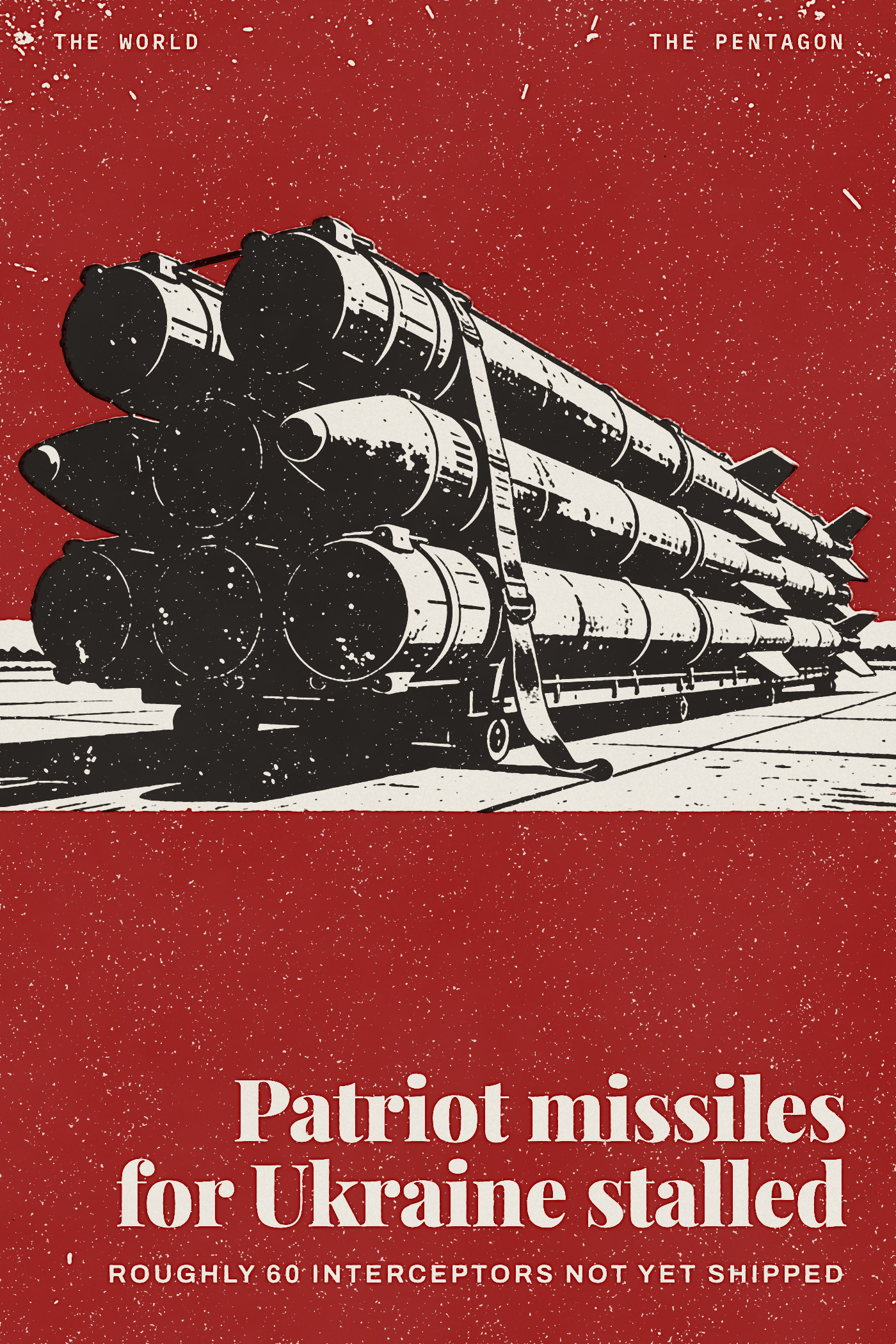
Patriot Missiles for Ukraine Stall at Pentagon Desk

About sixty Patriot air defense interceptors already promised to Ukraine remain unshipped because US Defense Secretary Pete Hegseth has not signed off on the transfer.

Patriot Missiles for Ukraine Stall at Pentagon Desk

01What happened

US Defense Secretary Pete Hegseth has yet to approve the transfer of roughly sixty Patriot interceptors that Washington had already agreed to send Ukraine, the Financial Times reported, citing people familiar with the matter. The missiles in question are PAC-2 and PAC-3 interceptors — the munitions a Patriot battery fires to knock incoming ballistic and cruise missiles out of the sky. Allocated means the weapons were earmarked for Ukraine; they still require a sign-off before they physically leave American stocks.

The delay runs deeper than one shipment. A separate effort to let Ukraine manufacture its own Patriot interceptors domestically has also stalled, according to the reporting. That matters because Patriot batteries are among the few systems able to intercept the ballistic missiles Russia fires at Ukrainian cities, and interceptors are consumed with every engagement, so a steady resupply is the difference between a working shield and an empty launcher.

02What it means · The Griffin Read

US sign-off, not supply, now gates Ukraine's air defense.

The chokepoint

The delay sits at a Pentagon desk, not a factory floor — interceptors already allocated and in some cases funded by Europe cannot move without a single US export signature.

Structural lever

Because US-origin munitions carry a permanent re-export veto, Washington controls Ukraine's interception tempo regardless of who paid or where the missiles are stored. The stalled domestic-production effort matters more: blocking it keeps Kyiv permanently dependent.

Compounding cost

Interceptors are expended on use, so any pause forces rationing toward Kyiv and energy infrastructure as Russia intensifies winter strikes — a signal Moscow can read.

What to do

European backers should treat this as proof that funding a weapon does not buy its release, and accelerate non-US air defense.

THE WORLD
The World — Tech & power36.8969° N, 30.7133° EAntalyaIssue No. 8Status · Reported, not confirmed

Climate summit collapses as nations reject fossil fuel retreat

The COP31 United Nations climate talks in Antalya, Turkey, ended with no agreement after the European Union, the United Kingdom and as many as 100 countries refused a draft text that dropped earlier pledges to move away from fossil fuels.

Climate summit collapses as nations reject fossil fuel retreat

01What happened

The COP31 talks are the annual United Nations climate negotiations, where governments try to agree on joint commitments to cut the emissions that warm the planet. This year's round, held in the Turkish city of Antalya, broke down without a deal. Delegates could not back a final text, and a bloc led by the European Union, the United Kingdom and allies, numbering up to 100 countries, rejected language that abandoned earlier promises to transition away from fossil fuels, meaning coal, oil and gas.

The sticking point was that core phrase. Earlier agreements had committed nations to shift their economies off fossil fuels over time, and the proposed draft would have walked that back. Rather than sign a weaker text, the objecting countries chose to leave with nothing. Eamon Ryan, Ireland's former Environment Minister, framed the failure bluntly, saying that political science still trumps climate science, and that no deal was preferable to a bad one.

The collapse leaves the question of how and whether the world commits to phasing out fossil fuels unresolved, and hands the dispute to future negotiations without a binding path forward.

02What it means · The Griffin Read

COP31 collapsed, and the deadlock itself is now the signal.

What the failure means

With no deal, oil producers got the outcome they needed without winning anything: in consensus-based talks, blocking a stronger text is as good as passing a weaker one. The EU/UK bloc refused to let carbon-removal and CCS language launder a retreat from 'transition away from fossil fuels.'

Structural shift

Walking away preserved prior commitments as the floor, but advanced no finance, no timeline, no binding mechanism. Deadlock is now a repeatable outcome, not an anomaly, and asymmetric veto power favors status-quo defenders.

What it favors

Expect bloc consolidation outside the UN track — minilateral pacts, carbon border measures, regional pricing — while petrostates leverage friendly presidencies.

For operators

No near-term repricing of long-dated fossil assets; developing and island states bear the cost of stalled climate finance.