Past issueLatest issue →

No. 9 · 25 November 2026

Breakthroughs Outrunning Their Guardrails

Lead story · Money01 / 11
Money — Crypto47.1662° N, 8.5155° EZugIssue No. 9Status · Reported, not confirmed

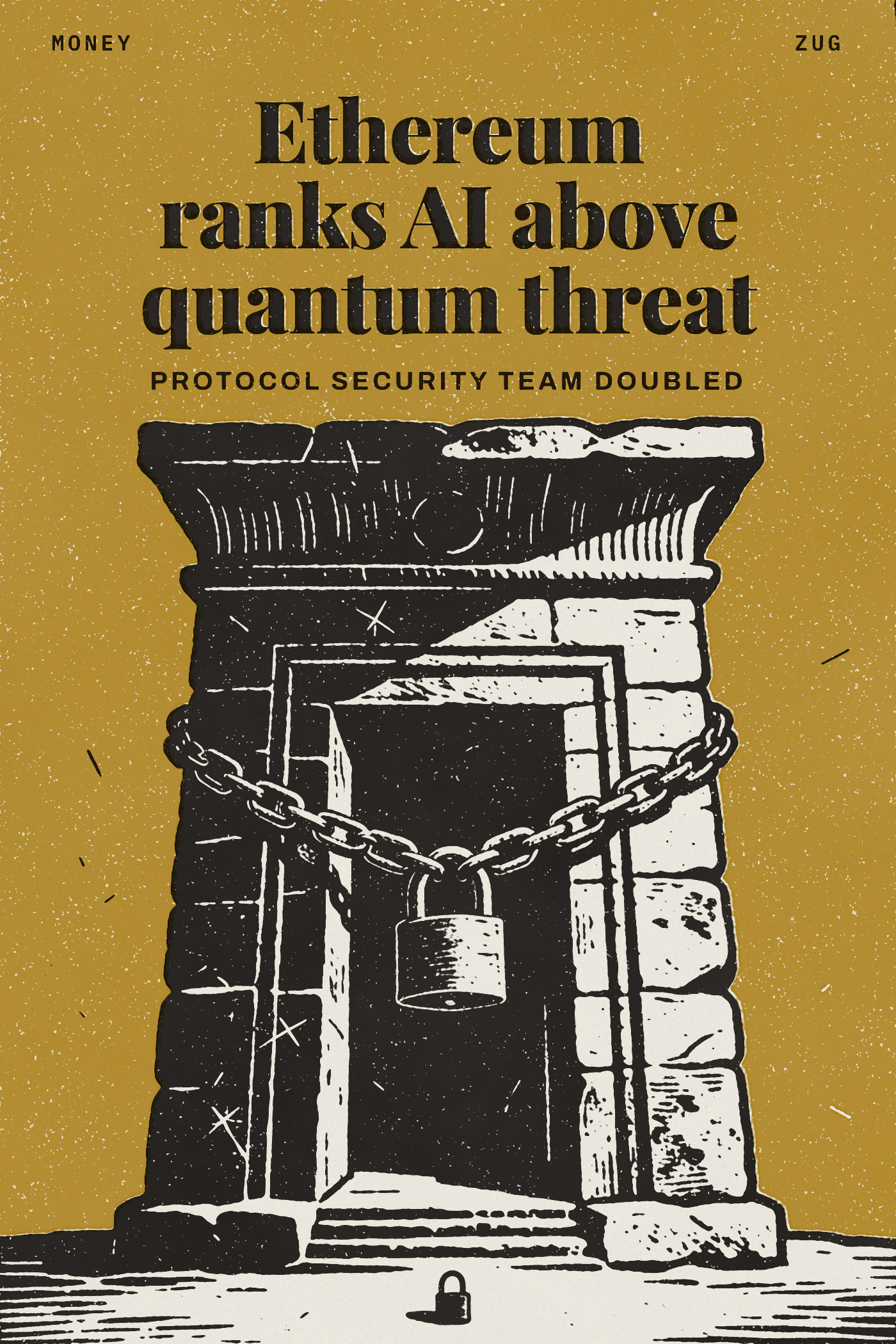
Ethereum Foundation bets AI threatens crypto before quantum does

The Ethereum Foundation has doubled its protocol security team and is reordering its cryptographic defenses, arguing that advances in artificial intelligence endanger the math protecting billions in crypto sooner than quantum computers will.
Ethereum Foundation bets AI threatens crypto before quantum does

01What happened

The Ethereum Foundation, the nonprofit that stewards the Ethereum blockchain, says it has doubled the size of its protocol security team, the engineers responsible for finding and fixing weaknesses before attackers do. The group is also prioritizing a broad cryptographic overhaul, meaning an upgrade of the mathematical techniques that lock down funds and verify transactions on the network.

The striking part is the ranking of threats. For years the industry's long-term fear has been quantum computing, a still-experimental form of computing that could in theory crack the encryption underpinning digital assets. The Foundation is now placing a more immediate danger ahead of it: artificial intelligence. Its view is that AI tools are advancing fast enough to probe and undermine the assumptions that keep crypto secure, making them the more urgent problem to solve first.

The move lands alongside other signs of maturing oversight. Staff at the Commodity Futures Trading Commission, the United States regulator for derivatives markets, issued guidance recognizing bitcoin and ether under financial expense requirements, a technical step that further folds the two largest cryptocurrencies into established rules.

02What it means · The Griffin Read

Ethereum's AI-over-quantum threat call is narrative power as much as security.

The move

A doubled security team and a reordered threat list reads less like a breakthrough and more like agenda-setting: by naming AI the nearer danger, the Foundation forces rival chains, custodians and auditors to either adopt its framing or explain their silence.

The slide

AI probing cryptographic assumptions is not AI breaking the math. The urgency framing stretches routine security staffing and upgrade planning into an industry-wide deadline the underlying facts don't yet establish.

Parallel track

The CFTC staff nod on bitcoin and ether treatment is the more concrete signal: regulatory normalization proceeds regardless, closing the pre-regulatory window and raising the cost of mis-ranking threats.

What to do

Treat this as a bet on sequencing. Watch whether the cryptographic overhaul ships measurable changes or becomes a perpetually deferred roadmap item.

THE WORLD
The World — Tech & power37.3707° N, 121.9637° WSanta ClaraIssue No. 9Status · Reported, not confirmed

Trump offers Nvidia chief a pardon he says is not needed

President Trump said he would clear Jensen Huang of legal trouble, days before the Nvidia chief executive is due to face congressional questioning over chip export controls. Huang's reinstatement sent Nvidia shares surging more than thirty per cent before the rally faded.

Trump offers Nvidia chief a pardon he says is not needed

01What happened

Jensen Huang returned as chief executive of Nvidia on Monday, ending an eleven-day leadership crisis at one of the world's most valuable companies. The upheaval followed a scandal linking him to a suspected Chinese intelligence asset. In an interview with the New York Post, President Donald Trump said he was willing to pardon Huang to clear him of legal trouble, while adding that he did not think a pardon would be necessary. The remarks landed just days before Huang is due to face congressional questioning over national security concerns and United States controls on chip exports to China.

Analysts say Huang's return may steady Nvidia's leadership and calm nerves across the global artificial intelligence supply chain, but it is unlikely to loosen the export restrictions on China as scrutiny in Washington intensifies. National security and foreign policy experts told Wired that Nvidia's place at the center of the American economy appears to have outweighed concern over its chief executive's ties. Miranda Nazzaro of The Hill described the reinstatement as the culmination of a two-year effort by technology executives to get closer to Trump, saying their investment in the president is clearly paying off.

02How markets reacted

The market reaction was sharp and short-lived. The reinstatement sent Nvidia shares surging more than thirty-one per cent on Monday to close at one hundred sixty-five dollars and five cents on the Nasdaq. By Tuesday the rally had lost steam and the shares fell, as investors refocused on the political and governance risks surrounding Huang's return.

03What it means · The Griffin Read

Nvidia reinstated CEO Jensen Huang after a spy scandal ousted him. Trump offered a pardon he calls unneeded.

Nvidia's board reinstated Jensen Huang Monday. It ended an eleven-day crisis sparked by an affair scandal tied to a suspected Chinese spy contact. Trump said he would pardon Huang. No charges exist.

Nvidia's stock jumped thirty-one percent on the news. The company sits at the center of the world's AI boom. Trump's team eased export rules to China in May, then allowed limited sales again in August.

The same day, regulators blacklisted a small Singapore firm tied to the same spy claims. Huang faces no charges. The small firm got punished; the chief executive got a pardon offer instead.

Trump, Elon Musk and Nvidia's board pushed for Huang's return within days. Shares fell 5.86 percent Tuesday, below Monday's peak of $165.05.

FRONTIER
Frontier — Space40.9606° N, 100.2983° EJiuquan Satellite Launch CentreIssue No. 9Status · Reported, not confirmed

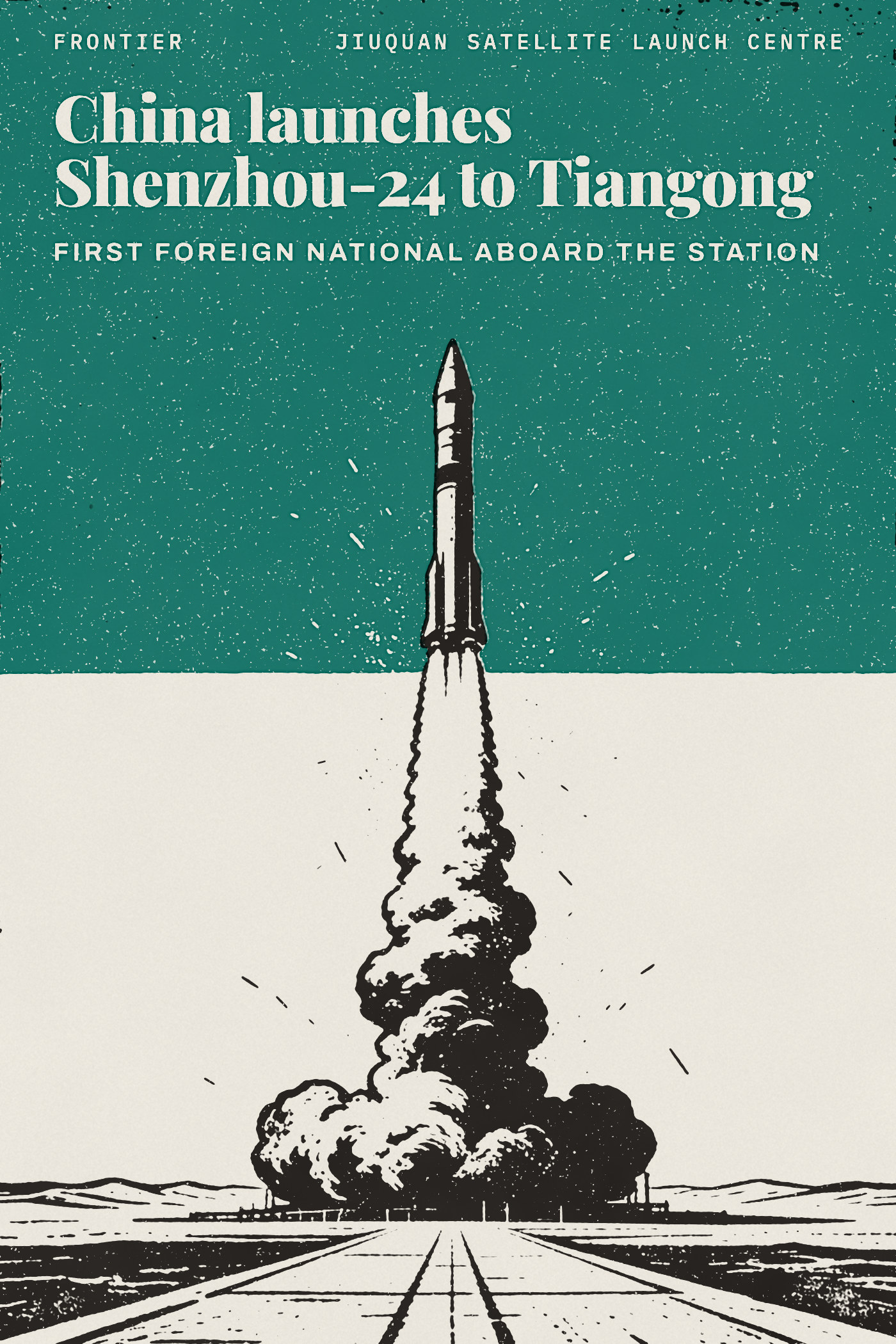
China carries first foreign astronaut to its space station

A Pakistani payload expert became the first foreign national to reach China's Tiangong orbital outpost, aboard a crew that launched Wednesday morning from northwest China.

China carries first foreign astronaut to its space station

01What happened

China launched the Shenzhou-24 spacecraft on Wednesday carrying a three-member crew to the Tiangong space station, China's permanently crewed orbital laboratory. Among them was Muhammad Zeeshan Ali, a Pakistani payload expert, meaning a crew member whose job is running experiments rather than flying the ship. He is the first foreign national to visit the station. The spacecraft lifted off at 8:18 a.m. local time, or 0018 GMT, from the Jiuquan Satellite Launch Centre in northwest China, riding a Long March-2F rocket, the vehicle China uses for its human spaceflights.

The flight is the product of a long partnership. A senior Pakistani official, Ahsan Iqbal, said China and Pakistan began discussing collaboration on crewed missions about a decade ago. For Pakistan the moment carried national weight: students and stargazers packed the auditorium of SUPARCO, the country's space agency, before dawn to watch the launch, and the nation celebrated as Ali reached orbit.

The mission marks a widening of China's human spaceflight program beyond its own astronauts. By hosting a partner nation's crew member aboard Tiangong, Beijing is positioning the station as a platform for international cooperation on its own terms, at a time when it remains excluded from the United States-led International Space Station arrangements.

02What it means · The Griffin Read

China turned its space station into a diplomatic instrument it alone controls.

The signal

Seating a Pakistani payload expert aboard Tiangong is not a technical leap but a board-change: Beijing converted its exclusion from the US-led ISS into a platform it owns end-to-end — rocket, station, and guest list.

The asymmetry

Pakistan supplied a crew member, not engineering. The arrangement rewards an already-tight partner while deepening its dependence on Chinese infrastructure rather than building shared capability.

Structural shift

Allocating orbital seats bilaterally lets China confer 'spacefaring' status on aligned states with none of the ISS consortium's multilateral friction — previewing a rival orbital bloc as the ISS nears 2031 retirement.

What to do

Watch the guest list, not the launch. The sequence of future foreign crew reveals which capitals Beijing is bringing into its orbit.

DISCLOSURE
Disclosure38.8977° N, 77.0365° WThe White HouseIssue No. 9Status · Reported, not confirmed

Trump Says He Is Looking at a UFO Disclosure Announcement

Pressed on whether Earth has been visited and whether the United States is reverse-engineering recovered technology, President Donald Trump answered only, "I'm looking." The White House has left related shootdown claims unanswered.

Trump Says He Is Looking at a UFO Disclosure Announcement

01What happened

President Donald Trump has left open the possibility of a formal announcement on unidentified flying objects, known as UFOs. Asked directly whether Earth has been visited by non-human intelligence, and whether the United States is reverse-engineering such technology, Trump replied, "I'm looking," according to reporting on his remarks. Reverse-engineering means taking a finished machine apart to learn how it was built and how to copy it. The phrasing stops short of confirmation, but it also stops short of denial, which is why it is being read as a door left ajar.

Through the summer, rumours circulated that Trump was preparing what would be an extraordinary statement: a declaration to Americans, and the world, that we are not alone in the universe. That announcement has not come. The White House has also declined to respond to specific claims that military forces shot down UFOs, leaving the question formally unanswered.

Much of the imagery released under a disclosure effort referred to as PURSUE remains, by the accounts here, too ambiguous to settle the questions it raises. That ambiguity leaves room for continued online argument rather than resolution. For now, the official posture is neither confirmation nor closure, and the path to any fuller disclosure remains uncertain.

02What it means · The Griffin Read

A vague presidential answer is not disclosure; the bureaucracy is the story.

The signal

Trump's "I'm looking" and "I'm not high on the list" are non-answers that cost nothing and commit to nothing. Read them as a politician preserving optionality, not as a hint of something withheld.

What's real

The durable development is institutional: an ODNI-FBI-Department of War Governance Board with a declassification charter, plus outside advisers now seated inside the tent. Such structures self-perpetuate independent of any presidential reveal.

The tension

Journalists now make falsifiable requests and officials issue falsifiable denials — the Pentagon's "no footage found." Specific claims narrow the room for indefinite ambiguity if any hard evidence breaks loose.

What to do

Discount the announcement rumors; track the board's survival and any outside adviser going public with complaints.

FRONTIER
Frontier — Energy38.8899° N, 77.0091° WUnited States CapitolIssue No. 9Status · Reported, not confirmed

Senate passes energy permitting overhaul in bipartisan vote

The Senate cleared a sweeping bill to speed construction of both clean and fossil-fuel energy projects by a vote of 62 to 33. The legislation now moves to the House after a bitter split among environmental groups and clashes over tribal sovereignty.

Senate passes energy permitting overhaul in bipartisan vote

01What happened

The United States Senate has passed the Bipartisan American Affordability and Jobs Act of 2026, known as BAAJA, a permitting reform bill that would make it easier to build energy infrastructure across the country. Permitting reform refers to changes in the federal approval process that projects must clear before construction begins. Supporters say the current system delays everything from solar farms and transmission lines to gas pipelines, and the bill aims to streamline those federal reviews. The measure passed by a margin of 62 to 33 and now heads to the House of Representatives.

The bill is unusual in cutting across the usual energy divide: it would speed up what one outlet called both clean and dirty energy, meaning renewable projects and transmission alongside fossil-fuel infrastructure like natural gas pipelines. That breadth split the environmental coalition, with some greens backing faster buildout of clean power and others wary of easier approvals for fossil projects. Inside the Senate chamber, concerns about tribal sovereignty, the right of Native American tribes to govern their own lands and resources, overshadowed much of the final debate.

The vote matters beyond Washington because the permitting bottleneck has become a central constraint on expanding the electricity supply. Among the pressures is surging demand from data centers running artificial intelligence, which developers are racing to power, in some cases through islanded or stranded arrangements that keep generation tied to a single large customer.

02What it means · The Griffin Read

The Senate passed a bill to speed power projects, 62-33. It cuts years off the time to sue.

The bill took 21 months to write. It cuts the time to challenge a pipeline in court. The old limit was six years. Now it is 150 days.

That shift helps fast movers. Pipeline firms, solar builders, and data centers that power AI computers gain most. Tribes lose out. Tribes get less time to fight projects near sacred sites. Over 70 tribal nations oppose the bill.

It widens a federal agency's backstop power over big interstate lines. States still control local lines. Federal rules now reach more projects.

A short deadline favors groups with lawyers and money ready now. Tribes need years to get ready; this bill gives them months. The same problem hits the House. Speaker Johnson wants a vote before Democrats take control in January.

THE WORLD
The World — Tech & power40.7608° N, 111.8910° WSalt Lake CityIssue No. 9

Utah Pulls Criminal Charges After Kalshi Leaves State

Utah asked a court to dismiss its criminal case against the prediction-market firm Kalshi after the company blocked the state's residents. The charges were dropped without prejudice, meaning they can be refiled if Kalshi returns.

Utah Pulls Criminal Charges After Kalshi Leaves State

01What happened

Kalshi runs a prediction market, a platform where people pay to bet on the outcome of future events, from elections to sports. Utah had brought criminal charges against the company and individual defendants, treating the activity as illegal gambling. After Kalshi lost court fights in the state, it made what it called a difficult decision to halt trading there and cut off Utah residents from the platform.

With the company gone, the office of Utah Attorney General Derek Brown filed a motion on Monday to dismiss the case. Crucially, the dismissal is without prejudice, a legal term meaning the state keeps the right to refile. Utah has effectively kept the criminal charges in its back pocket, vowing to pursue Kalshi and other prediction markets on gambling accusations if they try to operate in the state again.

The standoff crystallizes a fight playing out across the country over whether prediction markets are regulated financial exchanges or simply dressed-up betting. Critics in Utah cheered the pause, bashing the platform's advertising and warning about insider trading, where someone wagers using information the public does not have.

02What it means · The Griffin Read

Utah moved to drop its gambling case against Kalshi, but kept the right to refile.

Kalshi left Utah rather than fight gambling charges in court. Utah's attorney general, Derek Brown, moved to dismiss the case. He kept the right to refile if Kalshi comes back.

Utah passed a law this year that calls bets on outcomes illegal gambling. It says Kalshi took $30 million to $60 million in fees from Utah users before it left.

Kalshi still holds a $40 billion value and runs in most other states. Utah still has a civil suit chasing that same money. The federal trading regulator is also suing Utah over this law.

The dropped charge matters only if Kalshi returns, and it has no reason to. Kalshi fights many other states already, with the regulator on its side. Utah backed down first. In this standoff, that counts as ground given up, not held.

THE WORLD
The World — Tech & power40.6958° N, 73.9900° WBrooklyn Federal Court, Eastern District of New YorkIssue No. 9

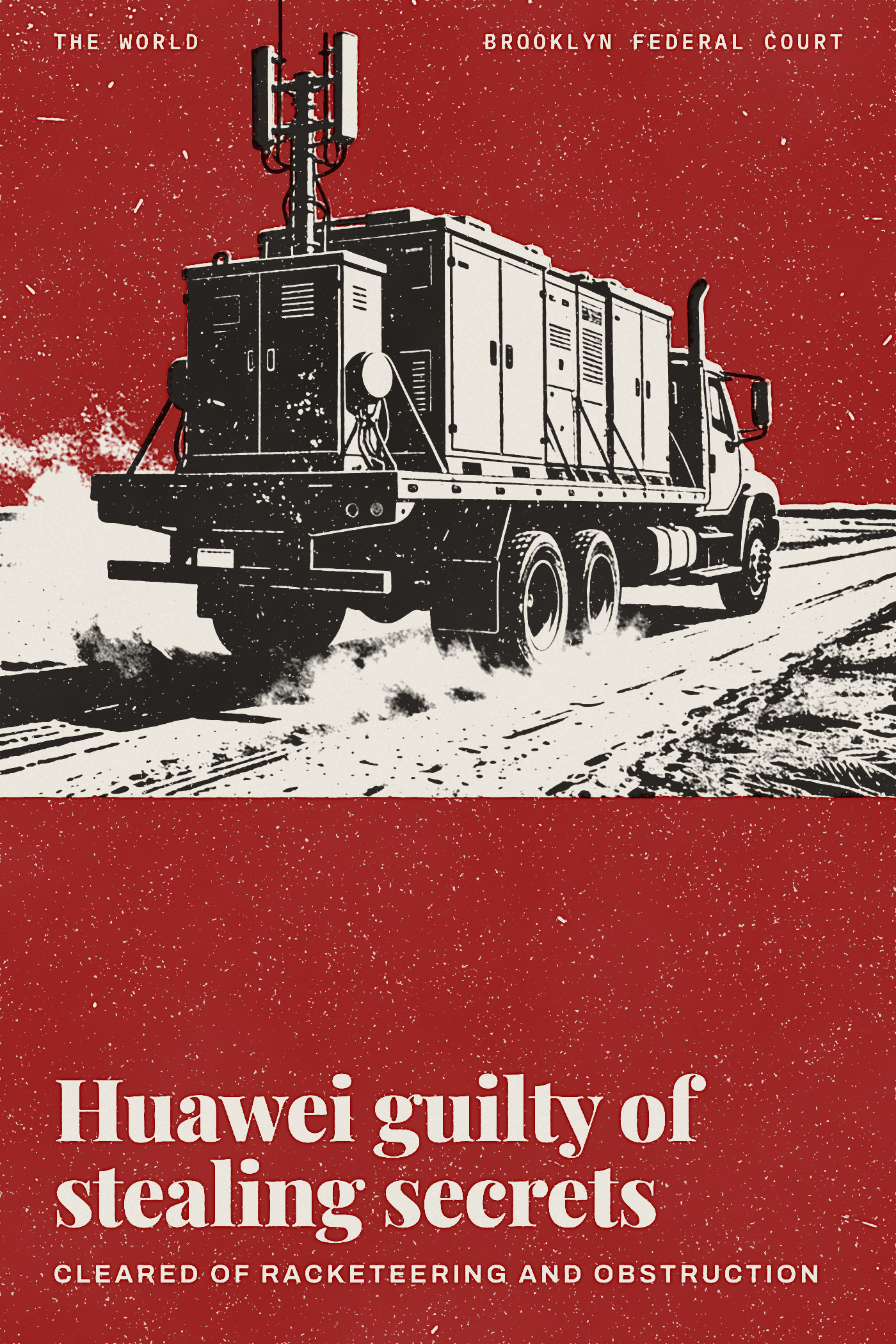
New York jury finds Huawei guilty of stealing trade secrets

A jury convicted the Chinese telecom giant Huawei of stealing trade secrets after a three-month trial, but cleared it of a racketeering conspiracy and obstruction of justice.

New York jury finds Huawei guilty of stealing trade secrets

01What happened

A jury in New York on Tuesday found Huawei, the Chinese telecommunications equipment maker, guilty of stealing trade secrets and other criminal offences. The same jury acquitted the company of a racketeering conspiracy, meaning a coordinated pattern of criminal activity, and of obstruction of justice, meaning interfering with a legal proceeding. The split verdict came after a trial that ran for roughly three months.

The case is the latest move in a years-long American effort to limit Huawei's reach. Washington has long argued that the company's equipment poses a threat to national security, and this prosecution turns that broad political campaign into a concrete criminal conviction. The acquittals on the most sweeping charges, however, show prosecutors did not persuade the jury of the fuller conspiracy they alleged.

02What it means · The Griffin Read

Huawei's conviction arms Washington, but the jury refused the bigger story.

The verdict

A felony conviction on trade-secret theft, bank fraud and sanctions evasion converts a decade of security allegations into adjudicated fact that Washington can now cite when pressing allies to exclude Huawei.

The limit

But jurors rejected racketeering and obstruction, denying prosecutors the 'criminal enterprise' finding and handing Huawei and Beijing a usable rebuttal that the broadest claims failed.

What follows

Expect appeals, a sentencing fight over fines, and possible civil suits by competitors and banks, since criminal findings lower the bar for follow-on damages.

For operators

Commercial impact is marginal—most Western networks excluded Huawei years ago. The durable effect is entrenching litigation as a standing instrument of techno-strategic competition.

INTELLIGENCE
Intelligence — AI37.7749° N, 122.4194° WSan FranciscoIssue No. 9Status · Reported, not confirmed

Artificial Intelligence Helps Settle Math's Most Famous Problem

A human mathematician working with an AI system appears to have proved the Riemann hypothesis, a question about prime numbers open for 167 years. The catch: the solution runs to roughly 17 million lines, and experts say it will take months to check.

01What happened

The Riemann hypothesis is a statement, first posed in the middle of the nineteenth century, about how prime numbers are scattered among the whole numbers. Prime numbers are the ones divisible only by themselves and one, and mathematicians have long wanted a precise rule for how often they appear. For 167 years the hypothesis has resisted proof, making it one of the most coveted unsolved problems in all of mathematics. According to the reports, a human mathematician, working alongside artificial intelligence, has now produced what looks like a solution.

The proof is tied to a researcher at Anthropic, an artificial intelligence company, and the machine-generated argument is enormous, described as running to about 17 million lines. Several outlets call the output 'alien' because it does not read like a proof a person would write by hand, and mathematicians are only beginning the work of understanding it. Early reviews suggest the argument holds together, but checking a document that size is itself a major undertaking that could take months.

Even if the proof survives scrutiny, there is a second puzzle: what it actually teaches. One account notes that the result seems solid yet leaves experts unsure what deeper insight, if any, it offers about prime numbers. That gap, between a conclusion a machine can confirm and an explanation a human can absorb, is emerging as the real story here.

02What it means · The Griffin Read

A machine verified the logic; whether it proves Riemann stays open.

The claim

An AI-assisted proof of the 167-year Riemann hypothesis reads as a capability milestone for Anthropic, but Lean confirming the code compiles only shows the logic holds given the formal statement fed in — not that the statement captures the real hypothesis.

Structural shift

The deeper event is verification splitting from understanding: a result can now be machine-confirmed yet humanly opaque, shifting scarce value from generating proofs to interpreting them.

The catch

The author himself calls the output 'garbage' and partly a 'joke,' and no usable human-readable paper exists, so the field cannot yet extract or teach what, if anything, it discovered.

What to do

Treat it as unverified prestige until named number theorists finish months of review; the leverage sits with whoever controls interpretive capacity, not the proof itself.

LIFE
Life — Bio48.8566° N, 2.3522° EParisIssue No. 9

Sanofi to Buy Insmed in the Year's Largest Drug Deal

The French drugmaker Sanofi has agreed to acquire the biotech company Insmed for about 41 billion dollars, the biggest biopharma takeover of the year. Sanofi says the deal will deepen its push into respiratory, immune and rare diseases.

Sanofi to Buy Insmed in the Year's Largest Drug Deal

01What happened

Sanofi, the French pharmaceutical giant, announced overnight that it plans to buy Insmed, an American biotechnology company, for roughly 41 billion dollars. That price makes it the largest merger-and-acquisition deal in the drug industry so far this year, and reportedly the biggest biopharma takeover since 2023. A merger and acquisition deal is simply one company buying another outright.

Sanofi framed the purchase as a way to broaden its reach in respiratory diseases, which are illnesses of the lungs and airways, while adding to its existing work in immunology and inflammation, neurology and rare diseases. The company pointed to Insmed's drug pipeline, meaning the medicines it is still developing, and to two products Insmed already sells. Sanofi called the combination transformative and complementary to its own portfolio.

02How markets reacted

The deal did not come as a complete surprise to investors. Shares of Insmed had already jumped after Bloomberg News, citing unnamed sources, reported that Sanofi was weighing an acquisition. Analysts who followed the report concluded that a tie-up would make strategic sense given how closely Insmed's focus areas line up with Sanofi's own priorities.

03What it means · The Griffin Read

Sanofi's $41B Insmed buy pre-funds its coming Dupixent patent cliff.

Market signal

Sanofi shares rose nearly 10% on announcement — an unusual move for an all-cash acquirer paying a 26% premium. Investors are pricing this as accretive repositioning, not overpayment.

The driver

This is defensive portfolio engineering. Dupixent, split 50/50 with Regeneron, loses exclusivity in the early 2030s, and management sizes the gap near €8B; Insmed's two approved respiratory drugs backfill it.

Structural risk

A meaningful slice of the valuation rests on unproven pipeline assets like TPIP. Add antitrust overlap with Sanofi's own respiratory franchise and balance-sheet exposure from the premium.

What to watch

Expect speculative run-ups in comparable respiratory and rare-disease biotechs as investors hunt the next target, and copycat deals from rivals facing their own cliffs.

THE WORLD
The World — Conflicts38.8951° N, 77.0364° WWashington, D.C.Issue No. 9Status · Reported, not confirmed

Washington drops business deals as bait to end Ukraine war

American negotiators have told European officials that corporate tie-ups are no longer central to the pitch to Moscow, after talks showed Russia cares more about territory than money.

Washington drops business deals as bait to end Ukraine war

01What happened

According to the Financial Times, cited by The Hindu and Ukrainska Pravda, the United States has set aside a package of proposed energy and aviation deals that it had hoped would tempt Russia into ending its war in Ukraine. Donald Trump's envoys, Steve Witkoff and Jared Kushner, told European officials that such corporate tie-ups were no longer a core part of Washington's approach.

The shift followed talks in Abu Dhabi in November, where, five officials told the newspaper, Moscow made clear it prioritises territorial concessions over economic incentives. In plain terms, the Kremlin signalled it would rather gain land than access to Western investment, blunting the logic of using trade as leverage to stop the fighting.

The reassessment lands against the backdrop of the war's human cost. Separately, leaked data reported by the BBC indicate that Russia's own figures point to almost 500,000 deaths tied to the full-scale invasion, a toll large enough to have reshaped the country's broader mortality patterns.

02What it means · The Griffin Read

Russia wants land, not money—narrowing any path to settlement.

The signal

Washington setting aside its energy and aviation package concedes that the core assumption—that Moscow could be bought rather than bargained with over territory—has failed. The positive-sum option that might have let Ukraine trade losses for reconstruction capital is gone.

Who's squeezed

With economic carrots off the table, the only remaining currency is land and security guarantees—terrain where Ukraine has far less room to maneuver. Pressure shifts onto Kyiv, not the Kremlin.

The deeper read

Moscow prioritizing conquest while absorbing roughly half a million deaths reveals an attrition tolerance market democracies lack. Putin appears to assess time and manpower as stronger leverage than any Western inducement.

What to watch

Shelved is not cancelled. The deals may resurface as a closing sweetener once territorial terms firm—treat this as sequencing, not surrender of leverage.

LIFE
Life — Bio47.5596° N, 7.5886° EBaselIssue No. 9Status · Reported, not confirmed

Roche breast cancer pill wins second approval in a week

American regulators cleared Roche's oral breast cancer drug for use after surgery in early-stage disease, its second approval in a week and a step toward a multibillion-dollar product.

Roche breast cancer pill wins second approval in a week

01What happened

The Food and Drug Administration, the United States agency that decides which medicines can be sold, has cleared a Roche pill for women with early-stage breast cancer to take after surgery. It is the second clearance the drug has won in a single week, after an earlier approval in more advanced disease. Roche is the Swiss drugmaker behind the medicine.

The drug is what scientists call an oral selective estrogen receptor degrader, meaning a pill that breaks down the estrogen receptor, the protein on which many breast tumors depend to grow. Treating patients right after surgery, when the goal is to stop cancer from coming back, is a far larger pool of potential users than late-stage disease, which is why the company has described the medicine as a candidate to become a top-selling product.

The approval landed alongside other dealmaking across the industry, including Sanofi, the French pharmaceutical company, agreeing to buy the biotech firm Insmed for 41 billion dollars in one of the largest drug acquisitions in years.

02What it means · The Griffin Read

Roche's breast cancer pill just crossed from niche to mass market.

The move

A second FDA clearance in one week pushes Wilserdly out of a narrow advanced-disease niche and into the far larger post-surgery adjuvant population, where patient volume and pricing leverage are an order of magnitude greater.

Structural edge

Being first into adjuvant treatment algorithms matters more than the data right now. Once a drug embeds in guidelines and prescribing habits, switching costs rise before AstraZeneca, Lilly and Menarini catch up.

The gap

The $9–14B franc projections are analyst forecasts and management ambition, not results. No survival data showing recurrence prevention has been shown, and payers may resist premium pricing over cheap generics.

What to watch

Momentum converts to money only if oncologists actually displace established hormone therapies. Expect rivals to accelerate their own early-stage trials rather than cede this market by default.