Past issueLatest issue →

No. 11 · 27 November 2026

Guardrails Under Pressure

Lead story · The World01 / 07
The World — The margin41.2865° S, 174.7762° EWellingtonIssue No. 11Status · Reported, not confirmed

New Zealand's governing coalition falls a seat short

Final results confirm Prime Minister Christopher Luxon's centre-right bloc missed a parliamentary majority by one seat, leaving him dependent on a centrist party to stay in power.

New Zealand's governing coalition falls a seat short

01What happened

New Zealand's ruling centre-right coalition, led by the National Party, has fallen short of the majority it needs to govern, according to final general election results released on Friday. The right-leaning bloc came up one seat short of the threshold required to control parliament, the count showed.

To remain Prime Minister, Christopher Luxon will need the support of the centrist Opportunity Party, which now holds the balance of power as the so-called kingmaker. That sets up delicate negotiations between Luxon, his existing coalition partners, and the centrist holdout before a government can be formed.

The arithmetic means no single bloc can govern alone, and the shape of the next administration depends on talks whose outcome the final tally has left unresolved.

02What it means · The Griffin Read

New Zealand's centre-right won the count but needs a kingmaker's consent.

The arithmetic

Special votes, which lean left, stripped two seats from the projected National bloc and turned an election-night majority into a one-seat deficit. The outcome is now decided in bargaining rather than at the ballot box.

The leverage

A seven-seat centrist party becomes the only path to a majority, extracting concessions far beyond its vote share. Labour's larger gains buy it nothing, because under proportional rules only a majority counts.

The cost

Luxon must satisfy three ideologically distinct partners at once, so campaign pledges on tax, energy and defence will likely soften or slip as the price of a deal.

The test

A four-party arrangement is inherently fragile; any single defection, or a collapsed negotiation, revives the threat of fresh elections and cautious, incremental government.


DISCLOSURE
Disclosure39.0836° N, 77.1527° WU.S. Nuclear Regulatory Commission HeadquartersIssue No. 11Status · Reported, not confirmed

Newly released records show drones over nuclear plants and airports

Documents pried loose through public-records requests describe drones flying over a California airport and a Virginia nuclear plant, including a pass over both reactor containment buildings.

Newly released records show drones over nuclear plants and airports

01What happened

Two batches of government records, obtained through the Freedom of Information Act, the law that lets the public demand federal documents, point to the same unsettling pattern: unidentified drones hovering over places that are supposed to be tightly controlled. The first set, released to the research site The Black Vault, covers a September 4, 2026, disruption at San Diego International Airport that delayed hundreds of flights. The files include air traffic control recordings and two Mandatory Occurrence Reports, the formal safety filings pilots and controllers submit, describing suspected drones near a runway. The recordings reference a possible shootdown, and the records indicate the military was prepared to engage the aircraft.

The second set, obtained by the outlet Liberation Times, describes repeated drone flights over Virginia's Surry Nuclear Power Plant in December 2024. One flight, according to the security reports, passed over both reactor containment buildings, the hardened structures that house the plant's nuclear reactors. The incidents near Langley Air Force Base add to a growing file of unexplained drone activity over sensitive American sites.

Neither release identifies who flew the drones or why, and in both cases the aircraft were described as suspected rather than confirmed. What the documents establish is that trained controllers, pilots and plant security staff logged the sightings seriously enough to file formal reports and, in the San Diego case, to weigh shooting an object down near a busy civilian airport.

02What it means · The Griffin Read

Repeated drone incursions expose a real gap: no detection, no interdiction.

The signal

The story's center of gravity is not the drones but the record itself: across 28 nuclear sites and a major airport, trained staff filed formal reports and, in San Diego, readied a shootdown — and every nuclear case closed unresolved. High alarm, zero attribution, zero interdiction is the actual finding.

Structural risk

That combination exposes a seams problem: no reliable chain to detect, classify and neutralize small drones over hardened infrastructure, and no clear authority between military, FAA, NRC and private security to act in real time.

Who benefits

Whoever is flying these systems — intentional or not — gains free reconnaissance, testing response thresholds through repetition without consequence. Unpunished overflights are themselves a strategic asset.

What to do

Treat persistent unresolved incursions as a capability gap to close, not an anomaly to catalogue; expect FOIA pressure to force counter-UAS authority and procurement onto the agenda.

THE WORLD
The World — The margin9.9281° N, 84.0907° WSan JoseIssue No. 11Status · Reported, not confirmed

Costa Rica turns away United Nations investigator at the airport

Costa Rica blocked Francesca Albanese, the United Nations special rapporteur, from entering the country, citing national security and alleged links to terrorist acts. She had flown in to accept an honorary degree from a public university.

Costa Rica turns away United Nations investigator at the airport

01What happened

Francesca Albanese, a United Nations special rapporteur, arrived at the airport serving San Jose, Costa Rica's capital, and was refused entry by national authorities. A special rapporteur is an independent expert appointed by the United Nations to monitor and report on a specific human rights issue. Officials said she was barred on grounds of national security and over what they described as links to terrorist acts.

Albanese had traveled to the country to receive an honorary degree from the University of Costa Rica, a public university. An honorary degree is an award given to recognize a person's work rather than completed coursework. Instead of attending the ceremony, she was stopped at the border and denied permission to enter.

The move is unusual because host governments rarely bar a sitting United Nations expert from entering their territory. By framing the refusal around national security and alleged terrorist links, Costa Rica placed a formal accusation against a United Nations official at the center of a routine academic visit.

02What it means · The Griffin Read

Costa Rica barred a UN rapporteur, turning alignment into enforcement.

The move

A sitting UN special rapporteur, already under US sanctions, was physically denied entry by a third state using the same 'terrorism links' framing. This converts a reputational dispute into a border-control action that other aligned governments can copy.

Structural gap

UN special procedures run on voluntary host-state cooperation and moral suasion, with no enforceable guarantee of entry or immunity. Costa Rica showed a mid-sized state can defect at low cost while banking favor with Washington and Israel.

Domestic fault line

The executive overrode a prestigious public university's academic prerogative, opening a sovereignty-versus-institutional-autonomy fight that could recur.

What to do

Treat this as a template. Watch whether other US- or Israel-aligned states adopt entry denials as a low-cost tool against mandate holders.

THE WORLD
The World — The margin40.4168° N, 3.7038° WMadridIssue No. 11Status · Reported, not confirmed

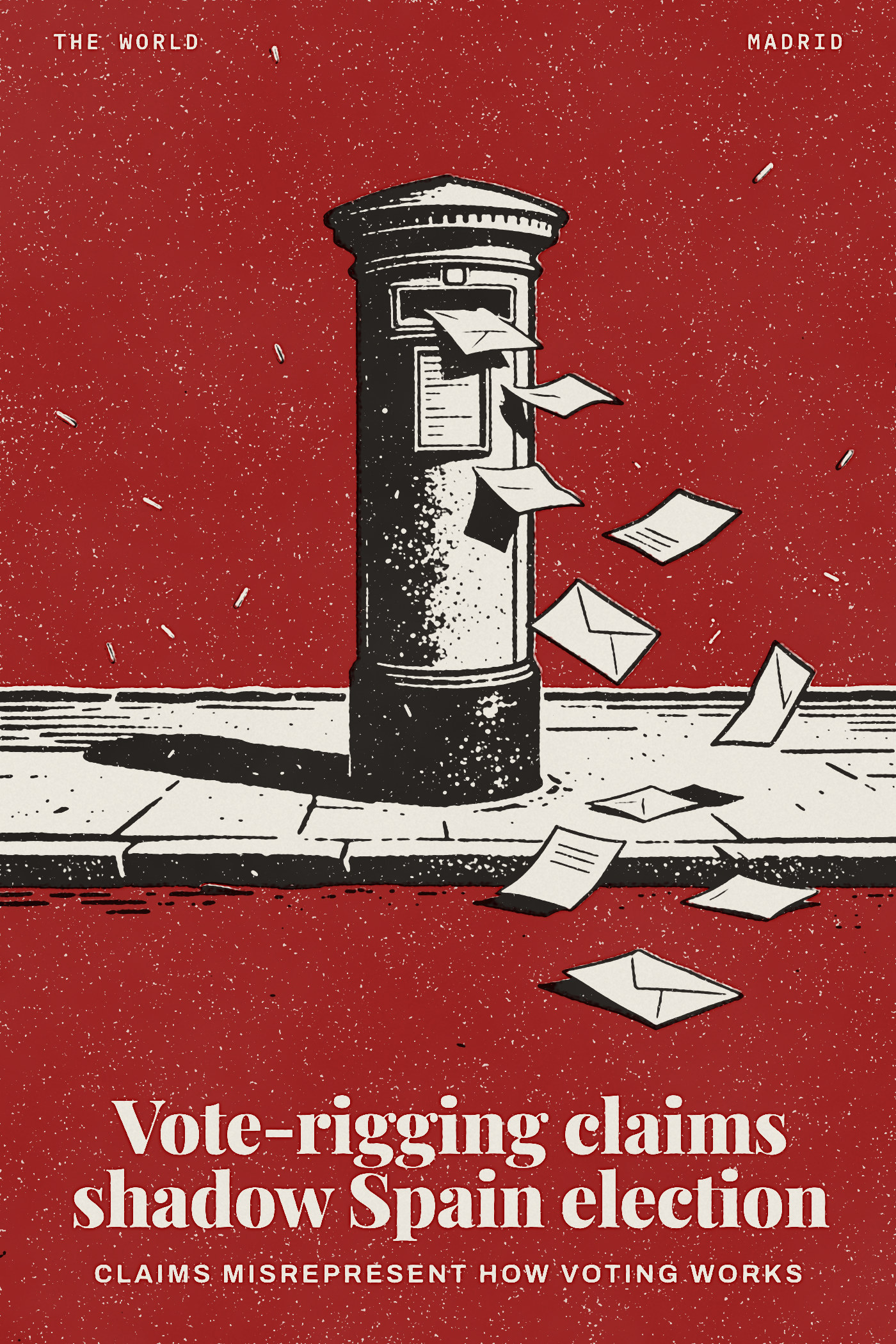
Viral vote-rigging claims shadow Spain's snap election

Allegations that Spain's government is fixing Sunday's snap election are spreading online, but fact-checkers say the claims misrepresent how the country's voting system actually works.

Viral vote-rigging claims shadow Spain's snap election

01What happened

Ahead of a snap election on Sunday, Spanish social media has filled with allegations of vote rigging, known in Spanish as pucherazo. The claims range from assertions that undocumented migrants are being illegally registered to vote, to warnings that postal ballots and the vote count could be manipulated, with internet users accusing Prime Minister Pedro Sanchez's government of trying to tilt the result. France 24's Vedika Bahl, reviewing the claims in the programme Truth or Fake, found that they misrepresent how Spain's electoral system works.

The vote itself carries high stakes. Sanchez is seeking a fourth term after eight years of leftist rule, and polls suggest voters could end that run. Much of the suspense centres on Santiago Abascal, leader of the far-right party Vox, which is tipped to act as kingmaker after the vote. Abascal, who has built his career on defending Spanish unity, is closer to national power than ever before.

The debunking matters because disinformation about rigged counts can erode trust in a result before it is even announced. By questioning how postal ballots and voter rolls are handled, the viral claims target the exact mechanisms that make a close and consequential election credible.

02What it means · The Griffin Read

Pre-positioned fraud claims aim to delegitimize Spain's vote before results.

The move

The pucherazo narrative surfaces before any count exists, and that timing is the tell. Deployed early, it hands a losing side a ready grievance and clouds any winner's mandate no matter who prevails.

The vector

The flagship Alcorcon claim traces to La Gaceta, an outlet tied to a foundation chaired by Vox's own leader. That makes this a coordinated messaging asset wearing the costume of independent reporting, not diffuse grassroots doubt.

Structural risk

Decentralized voter rolls and postal ballots are a durable, low-cost attack surface. Rebuttals arrive slower than virality and get recast by aligned media as establishment suppression of legitimate scrutiny.

What to watch

With Vox positioned as kingmaker, Abascal gains either way: a coalition seat or an aggrieved opposition bloc. Expect this playbook to travel to other European contests.

MONEY
Money — Crypto47.1662° N, 8.5155° EZugIssue No. 11Status · Reported, not confirmed

Ethereum sets December test for its Glamsterdam upgrade

After seven weeks of delays, developers will run the Glamsterdam upgrade on a test network on December 15, keeping contested new storage charges in place.

Ethereum sets December test for its Glamsterdam upgrade

01What happened

Ethereum is the second-largest blockchain, the shared ledger that runs programs known as smart contracts, which are pieces of code that move money automatically when their conditions are met. Developers have agreed to run the next major upgrade, called Glamsterdam, on a test network named Hoodi on December 15. A test network is a practice version of the blockchain where changes are rehearsed before they reach the real system that holds people's funds.

The schedule ends about seven weeks of delay. The holdup came from a dispute over gas pricing, the fees users pay to have the network store and run their code. Developers wanted to keep new storage charges, but some worried the changes could break smart contracts that already exist and depend on today's prices. They decided to keep the charges anyway.

Developers also looked ahead to the following upgrade, named Hegotá, and debated whether making Ethereum resistant to quantum computers should take priority over other planned changes. Quantum computers are a future machine that could, in theory, break the cryptography that protects blockchain accounts, so some argue the network should prepare now.

02What it means · The Griffin Read

Ethereum will test new fee rules on December 15. Security firms warned the changes can break live contracts.

Developers delayed the upgrade for seven weeks. Security firms warned new fee rules might break up to 15,000 contracts. They still set a test run for December 15. The fee rules stay unchanged.

Ethereum runs millions of smart contracts, small programs that move money on their own. The fee rules change what those programs must pay to run. A researcher, Ansgar Dietrichs, said more delay would push the test into 2027.

Contract owners must fix code built on old prices by January 10, 2027, or risk failure. Vitalik Buterin says the higher fees help the network grow.

Core developers set the rules every contract must follow. They also set the deadline. No date is set for the real network, so developers can wait while others race to keep up.

INTELLIGENCE
Intelligence — Compute38.9029° N, 77.0066° WFederal Communications Commission Headquarters, Washington, D.C.Issue No. 11

Regulator clears a million satellites to host data centers

The Federal Communications Commission authorized SpaceX to deploy up to one million satellites carrying artificial intelligence chips, a constellation that would multiply the number of objects in orbit roughly fiftyfold.

01What happened

The Federal Communications Commission, the United States agency that licenses who may broadcast from orbit, said Wednesday it had authorized SpaceX, the rocket company owned by Elon Musk, to deploy up to one million satellites fitted with artificial intelligence chips. The plan, which SpaceX calls Starmind, would place computing power that normally lives in warehouse-sized buildings on the ground into spacecraft circling the planet. The approval is the first the agency has granted for the idea.

The scale is the headline. A constellation of one million satellites would increase the number of spacecraft now in orbit by roughly fifty times. SpaceX is not alone in chasing the concept: Google and Blue Origin, the space company founded by Jeff Bezos, are also pursuing data centers in space. The appeal is that orbit offers constant sunlight for power and cold vacuum for cooling, two things that data centers on Earth fight to secure.

Approval is not the same as a working system. Industry analysis noted that the million-satellite plan exposes the hurdles to space-based data centers, from launching the hardware to keeping it running far from any repair crew. For now the agency has granted permission, not proof that the machines can do the work.

02What it means · The Griffin Read

SpaceX won approval for one million AI satellites in orbit. That is fifty times today's fleet.

The FCC approved SpaceX's Starmind plan on November 25. It rejected complaints from Amazon, Viasat, and astronomers worried about the night sky.

The plan puts AI chips on satellites that circle Earth. Space gives constant sunlight for power. Cold space also helps cooling.

The license sets binding deadlines. Launches must start by 2033. Ten percent of satellites must fly by 2035. All one million must fly by 2040. SpaceX raised $85.7 billion in June on this plan.

Nvidia wants to supply the chips. SpaceX stock closed at $130.41, up 2.33%. Amazon's stock fell 3.12% after its complaint failed.

SpaceX's chief financial officer, Bret Johnsen, says launches begin in 2027, six years ahead of the legal deadline. Hitting that date would show the plan works. Missing it breaks no rule; the real deadline is 2033.

THE WORLD
The World — The margin43.2698° N, 5.3958° EMarseilleIssue No. 11

Fan clashes mar Marseille win as French leaders condemn violence

Marseille beat Levski Sofia one-nil in the only French win of the Europa League night, but the match was overshadowed by crowd violence that drew condemnation from the French and Bulgarian leaders. Clashes broke out between supporters inside the stadium before kickoff.

Fan clashes mar Marseille win as French leaders condemn violence

01What happened

On Thursday, French clubs had a mixed night in the Europa League, the second-tier competition run by European football's governing body. Olympique de Marseille, the club from France's southern port city, defeated Levski Sofia of Bulgaria by one goal to nil, the only victory among the French sides. Lyon were held to a draw at home by Lillestrom of Norway, and Rennes lost to the Dutch side Nijmegen.

The Marseille result was overshadowed by violence. Clashes broke out between supporters of Marseille and Levski Sofia inside the stadium before the match began. The disturbance prompted condemnation from the leaders of both France and Bulgaria, who publicly denounced the scenes.

The excerpts do not detail injuries, arrests, or any sanction from the competition's organisers, nor do they describe what sparked the confrontation.

02What it means · The Griffin Read

A stadium brawl escalated to head-of-state diplomacy and a governance test.

The escalation

That armed, masked attackers breached segregation netting and sent Bulgarian fans to hospital pushed this past routine hooliganism — straight to Macron and Sofia on the phone. Heads of state engaging directly signals both the severity and the citizen-protection optics in play.

Structural gap

Weapons and masked assailants getting through pre-match screening expose a recurring hole in French and European stadium security design, independent of this one match.

Pressure point

UEFA now looks passive beside two engaged governments; Marseille faces likely disciplinary proceedings, while Sofia's investigation request keeps leverage on prosecutions and guarantees.

What to do

Treat the scoreline as noise; track whether this crystallizes into sanctions and protocol change or fades into statements.