China carries first foreign astronaut to its space station
A Pakistani payload expert became the first foreign national to reach China's Tiangong orbital outpost, aboard a crew that launched Wednesday morning from northwest China.
01What happened
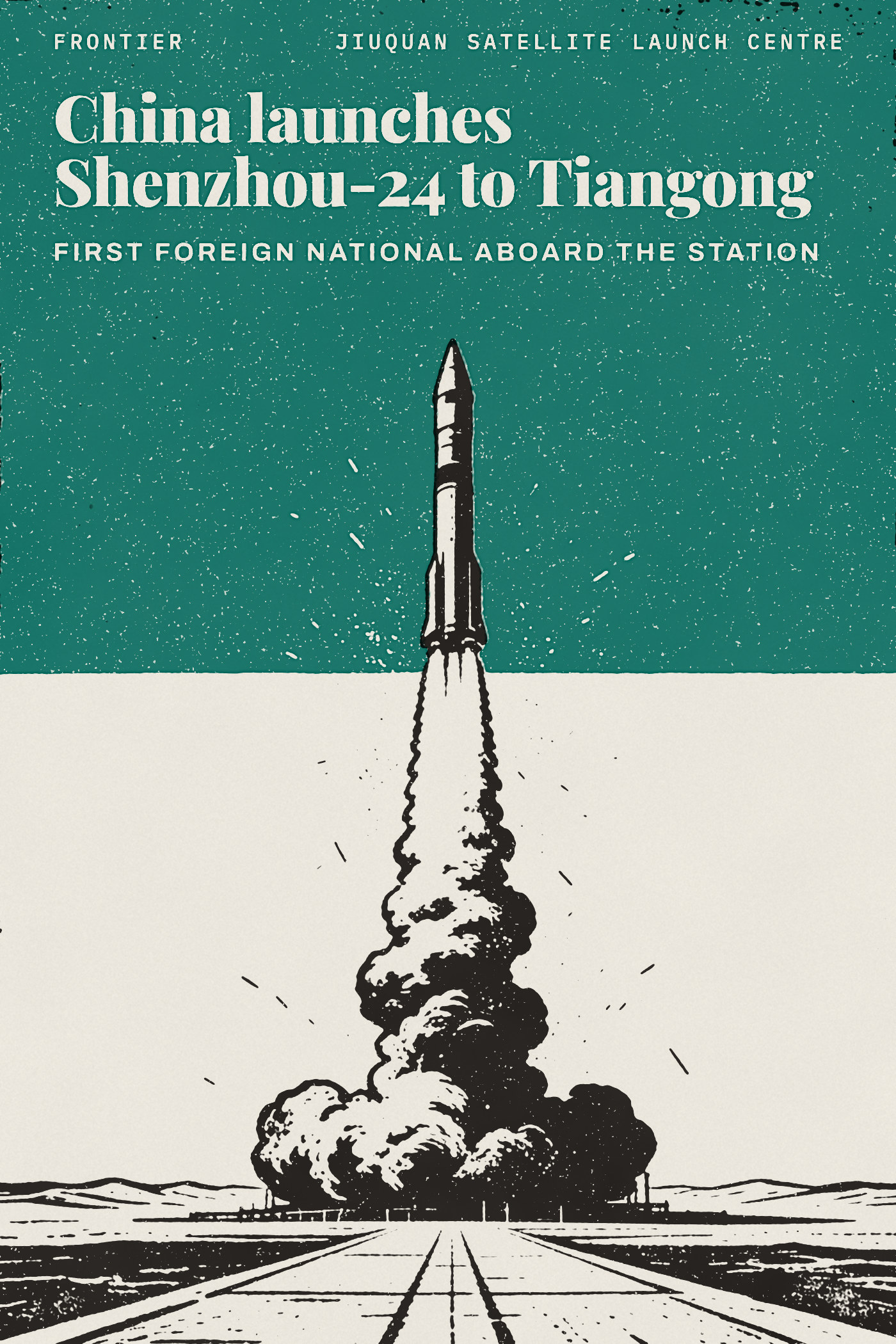
China launched the Shenzhou-24 spacecraft on Wednesday carrying a three-member crew to the Tiangong space station, China's permanently crewed orbital laboratory. Among them was Muhammad Zeeshan Ali, a Pakistani payload expert, meaning a crew member whose job is running experiments rather than flying the ship. He is the first foreign national to visit the station. The spacecraft lifted off at 8:18 a.m. local time, or 0018 GMT, from the Jiuquan Satellite Launch Centre in northwest China, riding a Long March-2F rocket, the vehicle China uses for its human spaceflights.
The flight is the product of a long partnership. A senior Pakistani official, Ahsan Iqbal, said China and Pakistan began discussing collaboration on crewed missions about a decade ago. For Pakistan the moment carried national weight: students and stargazers packed the auditorium of SUPARCO, the country's space agency, before dawn to watch the launch, and the nation celebrated as Ali reached orbit.
The mission marks a widening of China's human spaceflight program beyond its own astronauts. By hosting a partner nation's crew member aboard Tiangong, Beijing is positioning the station as a platform for international cooperation on its own terms, at a time when it remains excluded from the United States-led International Space Station arrangements.
02What it means · The Griffin Read
China turned its space station into a diplomatic instrument it alone controls.
Seating a Pakistani payload expert aboard Tiangong is not a technical leap but a board-change: Beijing converted its exclusion from the US-led ISS into a platform it owns end-to-end — rocket, station, and guest list.
Pakistan supplied a crew member, not engineering. The arrangement rewards an already-tight partner while deepening its dependence on Chinese infrastructure rather than building shared capability.
Allocating orbital seats bilaterally lets China confer 'spacefaring' status on aligned states with none of the ISS consortium's multilateral friction — previewing a rival orbital bloc as the ISS nears 2031 retirement.
Watch the guest list, not the launch. The sequence of future foreign crew reveals which capitals Beijing is bringing into its orbit.